Category: Migration

  • Netherlands Highly Skilled Migrant Visa from the UAE (2026): Salary Thresholds, Recognised Sponsors and the MVV in Dubai

    Netherlands Highly Skilled Migrant Visa from the UAE (2026): Salary Thresholds, Recognised Sponsors and the MVV in Dubai

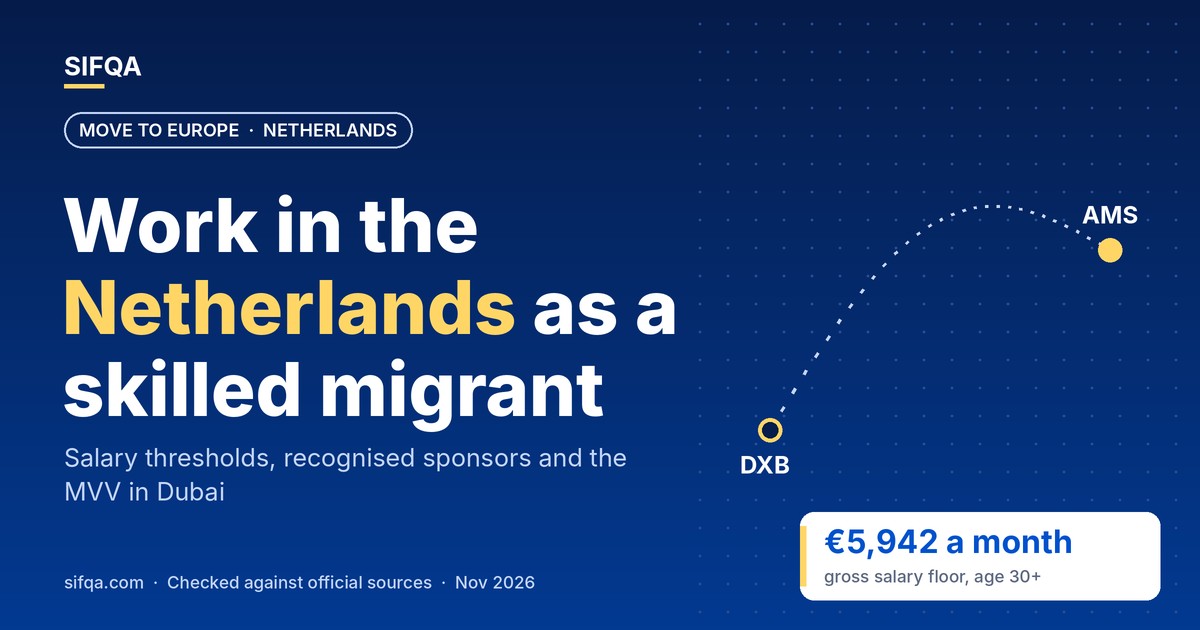
    To move to the Netherlands as a highly skilled migrant from the UAE, you need a job offer from an IND recognised sponsor paying at least €5,942 gross a month if you are 30 or older, or €4,357 if you are under 30 (2026 figures, excluding holiday allowance). The Dutch employer applies to the IND for you. Once approved, most nationalities collect an MVV entry visa at the Dutch Consulate-General in Dubai, booked through VFS Global. No degree is required for this route; the salary and the sponsor are what count.

    Checked on 4 November 2026 against the Netherlands Worldwide page for MVV applications in the UAE and the IND’s 2026 salary criteria (as published by Meijburg & Co). Salary thresholds change every 1 January.

    What salary do you need for a Dutch highly skilled migrant visa in 2026?

    CategoryGross monthly salary (2026)Approx. in AED a month
    Highly skilled migrant, 30 or older€5,942About AED 24,000
    Highly skilled migrant, under 30€4,357About AED 17,500
    Reduced criterion (Dutch-educated graduates, orientation-year holders)€3,122About AED 12,600
    EU Blue Card (Netherlands)€5,942About AED 24,000
    EU Blue Card, recent graduates€4,754About AED 19,200

    All amounts exclude the 8% holiday allowance. From 2026, only fixed, contractually guaranteed salary paid into your own bank account counts. Bonuses and allowances that the contract does not guarantee do not count. UAE-style housing and transport allowances usually do not exist in Dutch contracts, so compare your gross base pay, not your UAE package. AED amounts are rounded at about AED 4.03 to €1.
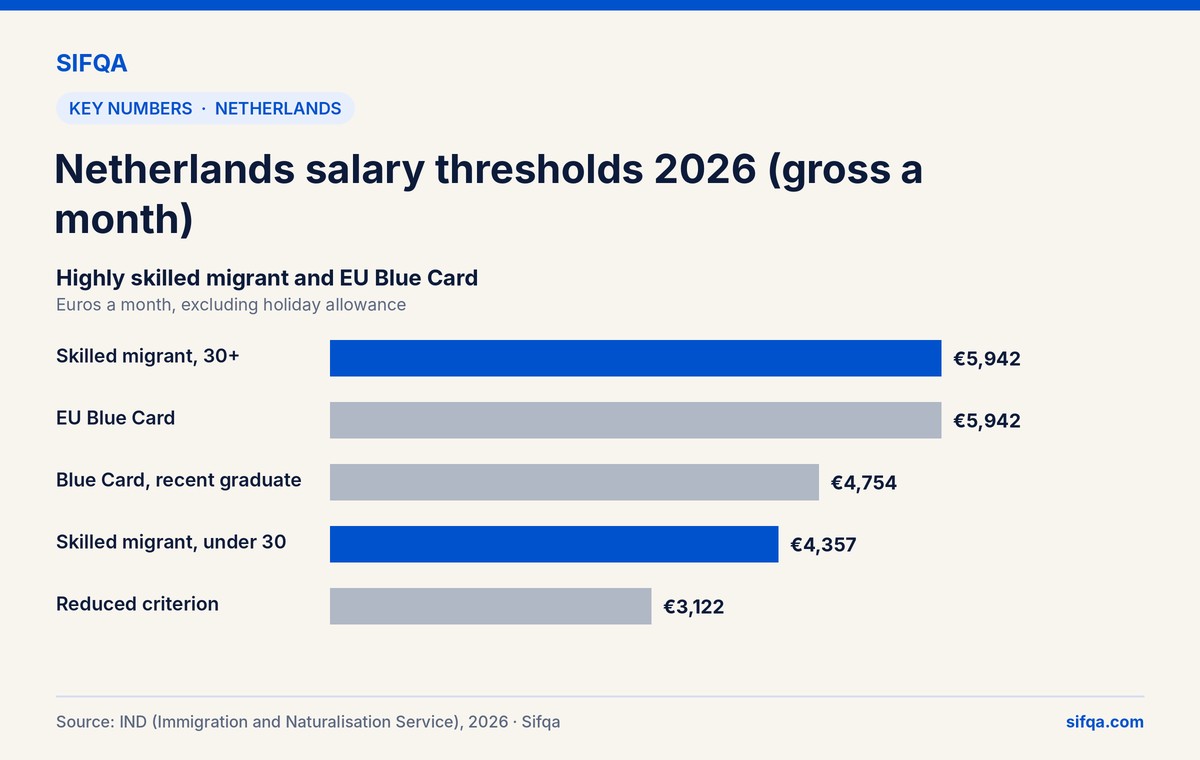
    Chart: Netherlands salary thresholds 2026 (gross a month)

    A recognised sponsor is an employer approved by the IND (Immigration and Naturalisation Service) to bring in highly skilled migrants. Only a recognised sponsor can apply for this permit. The IND publishes the full list in its public register of recognised sponsors. Check it before you accept an offer or pay anyone. If the company is not on the register, it cannot sponsor you through this route.

    How the process works from the UAE

    1. Get a job offer from a recognised sponsor at or above the threshold for your age.
    2. The employer applies to the IND for entry and residence (the TEV procedure). You sign an antecedents certificate, a declaration about any criminal past. The IND aims to decide within about two weeks for recognised sponsors.
    3. Check the IND approval letter. It must say that you can collect your MVV in the UAE. If it names another country, contact the IND before booking.
    4. Book an MVV appointment in Dubai through the VFS Global link on Netherlands Worldwide, within 3 months of the IND letter.
    5. Attend the appointment and hand in your passport. Processing takes up to 10 working days.
    6. Collect the MVV at the Consulate-General, Monday to Thursday, 9:00–11:00, with no appointment. Check your name and dates at the counter.
    7. Travel to the Netherlands, collect your residence permit at the IND desk and register at your municipality to get a citizen service number (BSN).
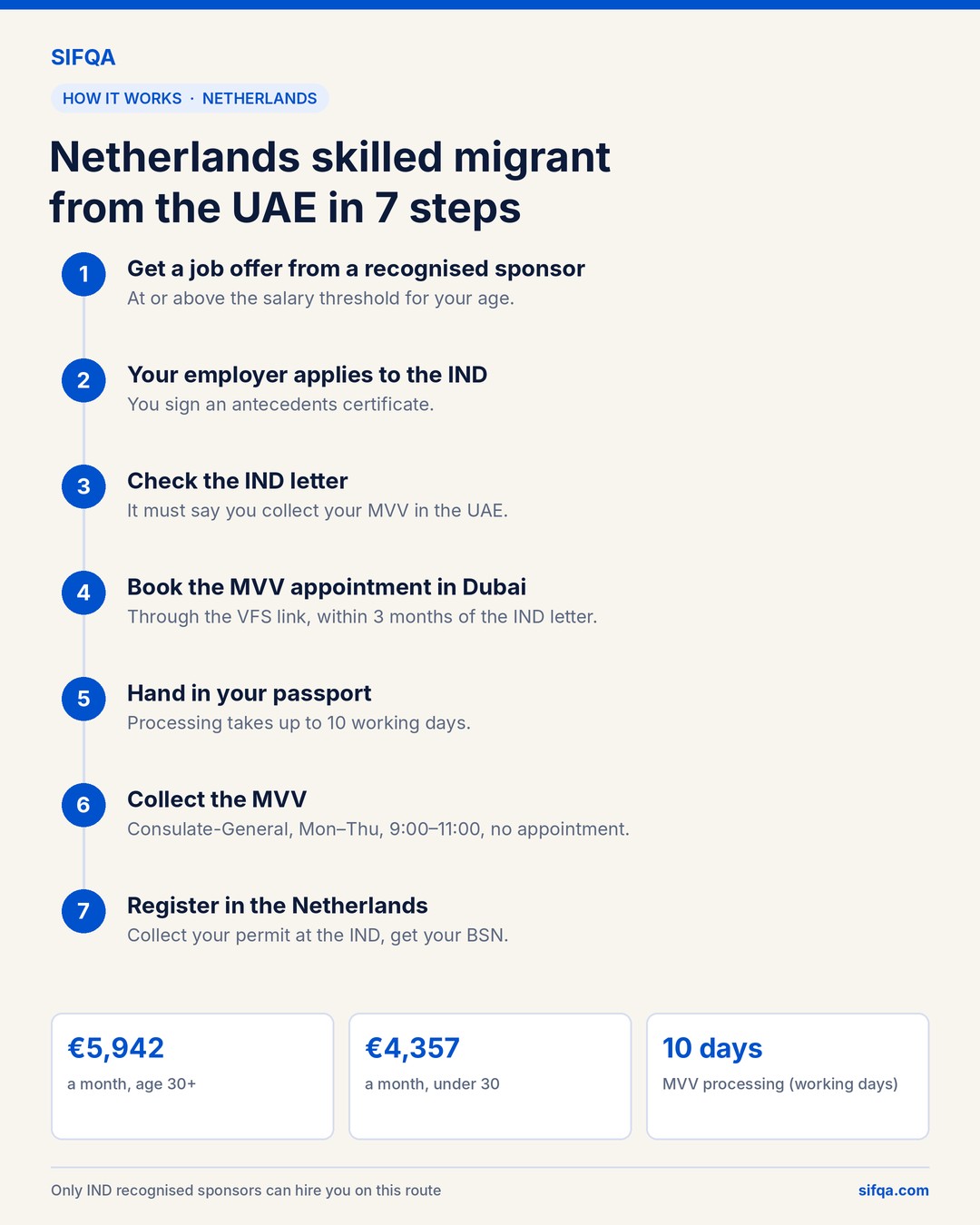
    Infographic: Netherlands skilled migrant from the UAE in 7 steps

    Documents for the MVV appointment in Dubai

    • Passport valid for at least 6 more months, with 2 blank pages, plus a copy of the photo page
    • One passport photo meeting Dutch requirements
    • A copy of the IND approval letter showing your V-number
    • Copies of any other documents listed in the IND letter
    • Your UAE residence permit and a copy, if you are not an Emirati

    Who needs an MVV?

    Your passport decides. Nationals of the EU, EEA and Switzerland, and of Australia, Canada, Japan, Monaco, New Zealand, South Korea, the United Kingdom, the United States and Vatican City, do not need an MVV. Everyone else does, including Emirati, Indian, Pakistani, Filipino, Egyptian, Sri Lankan, Bangladeshi and Nigerian nationals. Holding a UAE residence permit does not exempt you; it only lets you collect the MVV in Dubai. Depending on your nationality, you may also need a tuberculosis test after arrival.

    Can your family move with you?

    Yes. Your spouse or registered partner and your children can apply at the same time as you. The employer often submits their applications with yours. Your partner can work in the Netherlands without a separate work permit. Family members collect their MVVs at the same Dubai appointment if their IND letters say so.

    The 30% ruling: what changes in 2027

    Many highly skilled migrants recruited from abroad qualify for a tax-free allowance known as the 30% ruling. From 1 January 2027, it falls to 27% for rulings that started after 1 January 2024, and the minimum salary to qualify rises. If you come from the UAE, where there is no income tax, budget for Dutch tax on your full salary. Ask the employer whether it will apply for the ruling.

    Changing jobs, losing your job and permanent residence

    • New job: the new employer must also be a recognised sponsor and pay at least the threshold. It reports the change to the IND.
    • Job lost: you normally get a search period of 3 months to find a new sponsor.
    • Permanent residence: after 5 years of continuous legal residence, if you pass the civic integration exam.

    Questions people ask

    Can I apply for a Dutch highly skilled migrant visa myself from Dubai?

    No. The recognised sponsor employer submits the application to the IND. You only attend the MVV appointment in Dubai afterwards.

    Do I need a degree for the highly skilled migrant permit?

    No. The highly skilled migrant permit is based on salary and sponsor. The Dutch EU Blue Card is the version that requires a degree.

    Where do I collect my MVV in the UAE?

    At the Consulate-General of the Netherlands in Dubai, booked through VFS Global. You can only go there if the IND letter says you can collect in the UAE.

    Does my UAE salary count towards the threshold?

    No. Only the gross salary paid by the Dutch employer counts, excluding holiday allowance.

    Can my wife work in the Netherlands?

    Yes. A partner of a highly skilled migrant can work without a separate work permit.

    Related guides

    Sources

    Written by Asad Waleed M, Dubai. Asad has lived in the UAE for nine years and researches visa rules from government sources. He is not an immigration lawyer or consultant, and Sifqa does not process applications or sell visa services. Read the editorial policy.

    Last checked 4 November 2026. Dutch salary thresholds change every 1 January. Found an error? Email ionicwaleed@gmail.com and it will be fixed and logged.
  • Portugal D7 and Digital Nomad (D8) Visa from the UAE (2026): Income, Documents and Steps from Dubai

    Portugal D7 and Digital Nomad (D8) Visa from the UAE (2026): Income, Documents and Steps from Dubai

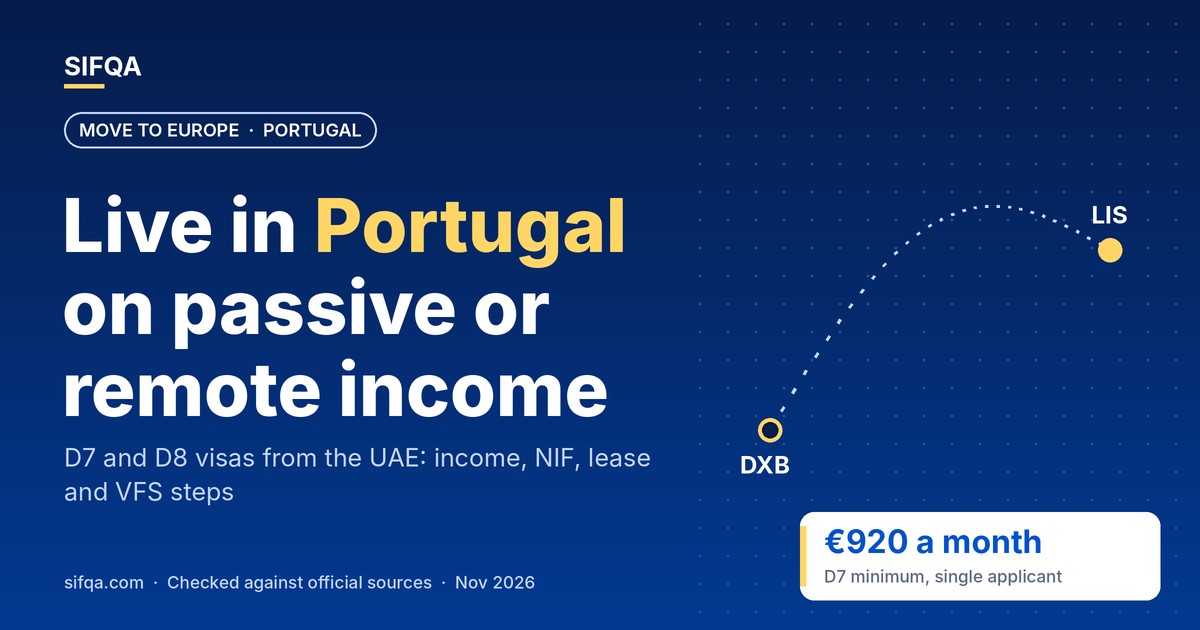
    To move to Portugal from the UAE without a Portuguese job, you need either a D7 visa, based on passive income of at least €920 a month in 2026, or a D8 digital nomad visa, based on remote-work income of at least €3,680 a month. UAE residents apply through VFS Global in Dubai or Abu Dhabi for the Embassy of Portugal in Abu Dhabi. Your UAE police clearance must carry a UAE Ministry of Foreign Affairs (MOFA) stamp.

    Checked on 4 November 2026 against the VFS Global checklists for Portugal in the UAE and the 2026 Portuguese minimum wage of €920 a month (Decreto-Lei 139/2025). Income thresholds are tied to the minimum wage and change each January.

    D7 or D8: which Portugal visa fits you?

    D7 (passive income)D8 (digital nomad)
    Income typePension, rent, dividends, interest, royaltiesSalary or freelance income from outside Portugal
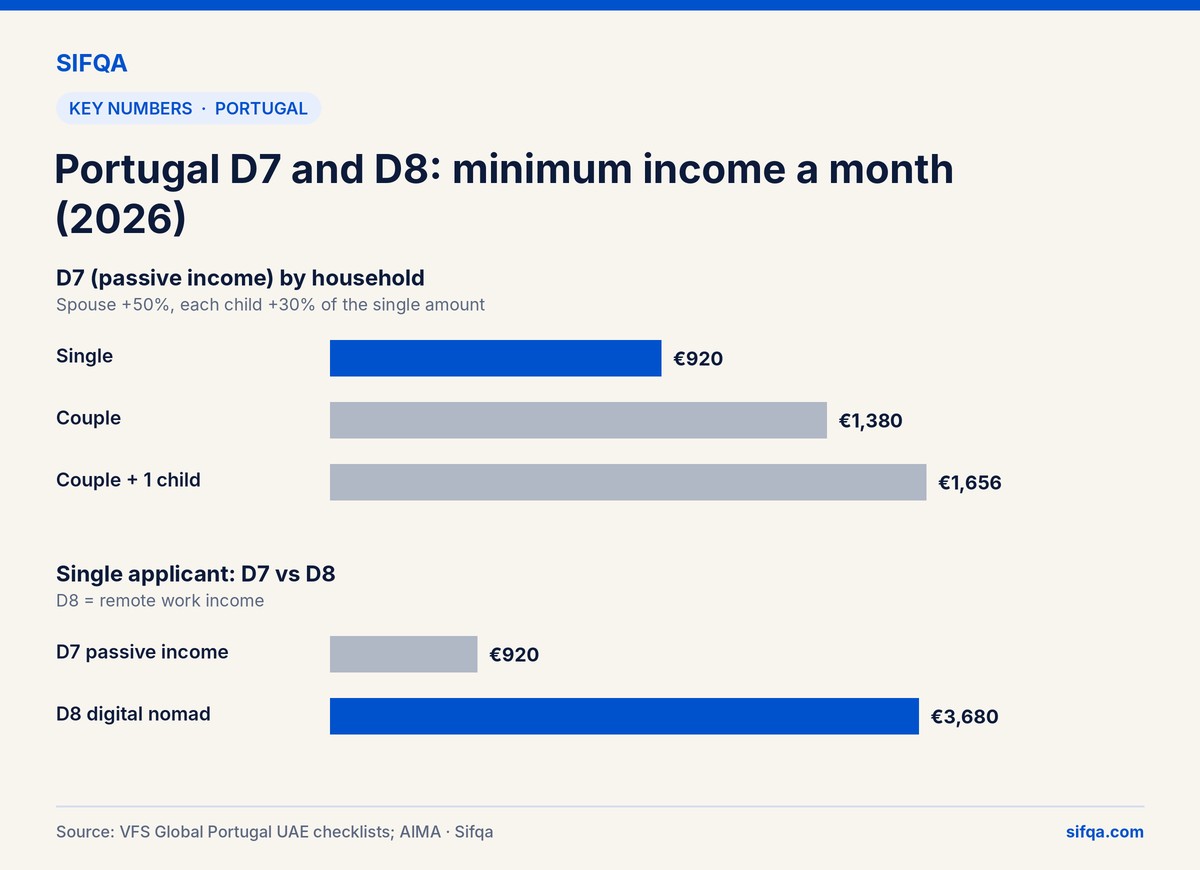
    Minimum income, single (2026)€920 a month€3,680 a month (average of the last 3 months)
    Approx. in AEDAbout AED 3,700 a monthAbout AED 14,800 a month
    Couple€1,380 a monthHigher; spouse added to the main amount
    Can you work in Portugal?Yes, once you hold the residence permitYes, for your foreign employer or clients
    Leads to permanent residence?Yes, after 5 yearsYes, if you take the residence version (not the temporary-stay version)
    Fits UAE residents who…Own rental property, have investments or a pensionKeep a UAE or other foreign job remotely, or freelance for foreign clients

    Each extra family member raises the D7 amount. A spouse adds 50% (€460) and each child adds 30% (€276). Most applicants also show about 12 months of the threshold in savings in a Portuguese bank account, which is €11,040 for one person.

    Can I use my UAE job for the D8 digital nomad visa?

    Yes, if your UAE employer agrees in writing that you can work from Portugal and you earn at least €3,680 a month. The UAE checklist asks for an employment contract stamped by MOFA, or an employer declaration confirming the job. You also need three months of bank statements showing the salary, stamped by MOFA. Freelancers instead show a service contract or company documents, three months of income and a tax residence certificate. In the UAE, the tax residence certificate is issued by the Federal Tax Authority.

    Housing, transport and other allowances on a UAE payslip are usually treated as income if they are paid regularly into your account. Keep the payslip breakdown ready.

    Chart: Portugal D7 and D8: minimum income a month (2026)

    Documents for a Portugal D7 visa from the UAE

    • National visa application form, typed and signed (handwritten forms are not accepted)
    • Two passport photos, one fixed to the form
    • Passport valid beyond your planned stay, plus a copy of the photo page
    • Valid UAE residence permit and Emirates ID, if you are not an Emirati
    • Travel medical insurance covering medical costs, urgent care and repatriation
    • Police clearance certificate from the UAE (stamped by UAE MOFA) and, where required, from your country of nationality. See UAE police clearance for immigration.
    • Request for a Portuguese criminal record check (form provided by VFS)
    • Proof of passive income: pension letters, rental contracts with rent received, dividend or interest statements
    • Accommodation in Portugal: a lease signed on the last page by landlord and tenant and initialled on every page
    • Portuguese bank documents, stamped and authenticated by a lawyer in Portugal

    You need a Portuguese tax number (NIF) before you can open a Portuguese bank account or sign a lease. Non-EU residents usually get one through a fiscal representative in Portugal.

    How to apply from Dubai or Abu Dhabi: step by step

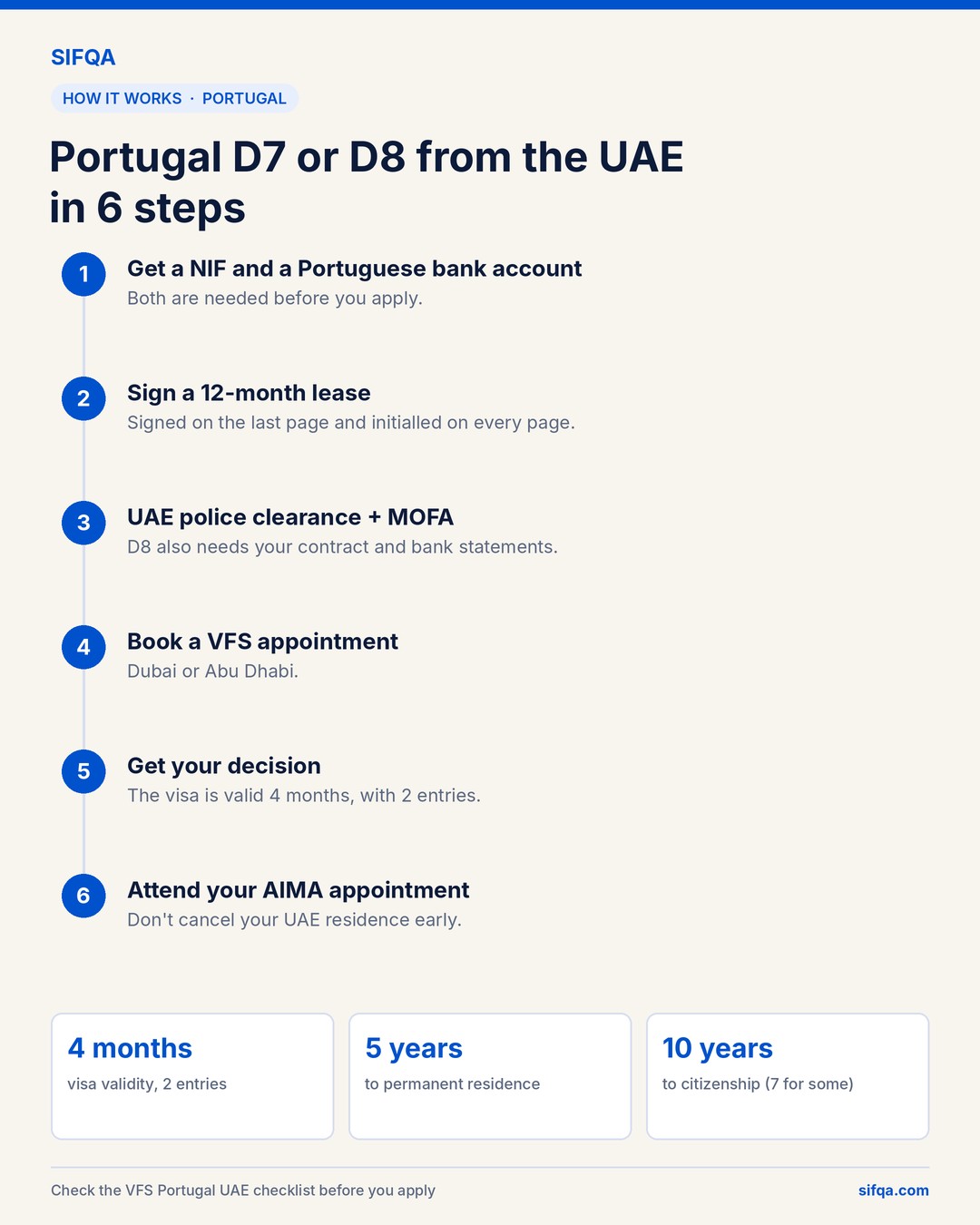
    1. Get a NIF and open a Portuguese bank account. Transfer your savings so the bank statement shows them.
    2. Arrange accommodation. Sign a lease for a home in Portugal, ideally for 12 months.
    3. Get your UAE police clearance and MOFA stamps. D8 applicants also need the MOFA stamp on their employment contract and bank statements.
    4. Book a VFS Global appointment for a Portugal national visa and submit your file with biometrics.
    5. Wait for the decision. The visa is valid for 4 months and allows two entries.
    6. Travel to Portugal and attend your AIMA appointment to get the residence permit card. Do not cancel your UAE residence until the visa is in your passport.
    Infographic: Portugal D7 or D8 from the UAE in 6 steps

    After you arrive: residence permit, renewals and time outside Portugal

    • Residence permit: AIMA (the Agency for Integration, Migration and Asylum) issues the card. The first permit is usually 2 years, renewable for 3.
    • Time outside Portugal: long absences can cost you the permit. The usual limit is 6 months in a row, or 8 months in total during the permit’s validity. This matters if you plan to keep working in Dubai part of the year.
    • Permanent residence: after 5 years of legal residence.
    • Citizenship: since 19 May 2026, the new nationality law (Lei Orgânica 1/2026) requires 10 years of legal residence for most nationalities (7 for EU and Portuguese-speaking countries). The time counts from the date your first residence permit is issued, and you must pass Portuguese language and civic requirements.

    Can my family come with me?

    The rules tightened in October 2025. Under Law 61/2025, a D7 or D8 holder generally must hold a residence permit for two years before applying for family reunification with a spouse or partner. The wait is 15 months for couples who can prove 18 months of living together before the move. Minor children and dependent children in education are exempt from the wait. Ask the embassy before you apply whether your spouse can apply alongside you, because practice is still settling.

    Common reasons for refusal

    • Income that is irregular or comes from salary (for D7), not from passive sources
    • Police clearance without the UAE MOFA stamp
    • A short-term holiday booking instead of a real lease
    • An expired or soon-expiring UAE residence permit
    • For D8: an employer letter that does not clearly allow you to work from Portugal

    Visa fees are not refunded if you are refused.

    Questions people ask

    How much income do I need for a Portugal D7 visa in 2026?

    At least €920 a month for the main applicant (about AED 3,700), plus €460 for a spouse and €276 for each child. Most applicants also show a year’s worth of this in savings.

    Can I apply for the D7 in Dubai if I am not Emirati?

    Yes, if you hold a valid UAE residence permit. You apply through VFS Global for the Embassy of Portugal in Abu Dhabi.

    Does my UAE salary count for the D7?

    Not usually, because the D7 is for passive income. If you will keep your UAE job remotely, the D8 digital nomad visa fits better.

    How long does the Portugal D7 visa take from the UAE?

    Plan for about two to four months, including the time it takes to get MOFA stamps, a NIF and a bank account before you apply.

    Can I get Portuguese citizenship after 5 years?

    Not any more for most nationalities. Since 19 May 2026, the requirement is 10 years, or 7 for EU and Portuguese-speaking countries, counted from your first residence permit.

    Is the Portugal D7 visa the same as a golden visa?

    No. The D7 is based on income and requires you to live in Portugal. The golden visa is an investment route with low minimum stays.

    Related guides

    Sources

    Written by Asad Waleed M, Dubai. Asad has lived in the UAE for nine years and researches visa rules from government sources. He is not an immigration lawyer or consultant, and Sifqa does not process applications or sell visa services. Read the editorial policy.

    Last checked 4 November 2026. Portugal’s thresholds follow the minimum wage and change each January. Found an error? Email ionicwaleed@gmail.com and it will be fixed and logged.
  • How to Move to Europe from the UAE (2026): Work Permits, Self-Funded Visas and Family Routes Compared

    How to Move to Europe from the UAE (2026): Work Permits, Self-Funded Visas and Family Routes Compared

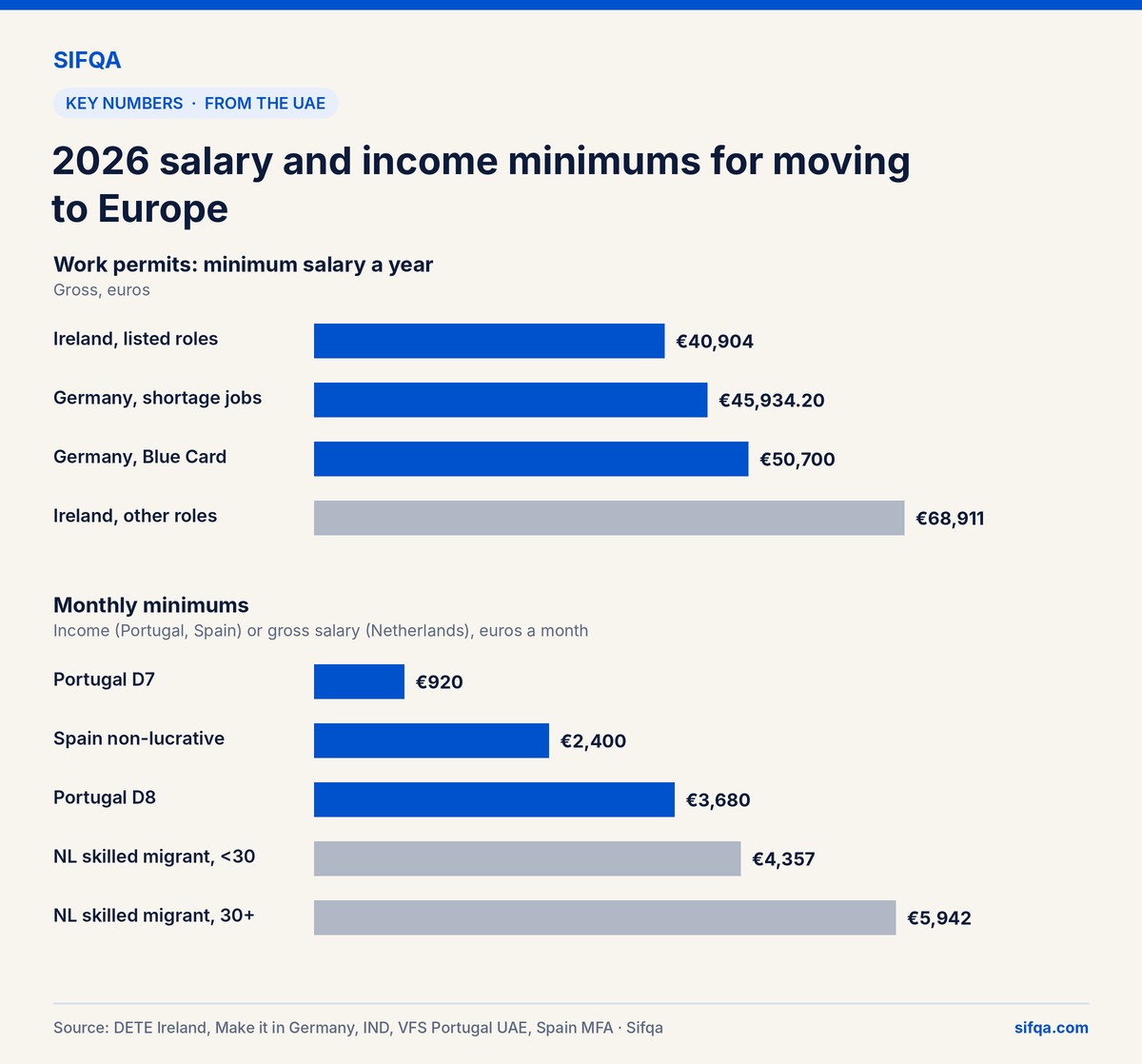
    There are five legal routes for a UAE resident to move to Europe: a job offer with a work permit, a job-search visa, a self-funded or remote-work visa, a study visa, or a family route. For most expats, the job-offer route is the fastest. In 2026 it means a salary of at least €40,904 a year in Ireland (Critical Skills, degree-level roles), €45,934 to €50,700 a year in Germany (EU Blue Card) or €5,942 a month in the Netherlands (Highly Skilled Migrant, age 30+). If you can live on passive income or remote work, Portugal and Spain are the main options.

    Thresholds checked on 4 November 2026 against government and official provider sources listed at the end. Your passport decides whether you need a visa to enter. Your UAE residence decides where you apply: you normally lodge a long-stay (national “D”) visa at the embassy or visa centre in the UAE, not in your home country.

    What are the ways to move to Europe from the UAE?

    RouteWho it suitsMain examplesCan you work?
    Job offer + work permitProfessionals with a degree or in-demand skillsGermany EU Blue Card, Netherlands Highly Skilled Migrant, Ireland Critical SkillsYes, for the sponsoring employer at first
    Job-search visaSkilled workers without an offer yetGermany Opportunity CardLimited part-time and trial work
    Self-funded (passive income)Retirees, landlords, investors, people with savings incomePortugal D7, Spain non-lucrative visaPortugal D7: yes; Spain non-lucrative: no
    Remote work / digital nomadPeople employed or freelancing for clients outside the destination countryPortugal D8, Spain digital nomad visaYes, for your foreign employer or clients
    StudyStudents and career changersMaster’s degrees in Germany, the Netherlands, Ireland, FranceLimited hours during study
    FamilySpouses and children of EU citizens or of permit holdersEU free-movement rules; national family reunificationUsually yes

    Investment (“golden visa”) routes still exist in a few countries, but they are expensive and changing fast. Spain closed its golden visa in April 2025. Portugal’s golden visa no longer accepts property purchases. These routes are outside the scope of this guide.

    Salary and income thresholds by country (2026)

    Country and visaMinimum you must showApprox. in AEDNeed a local job offer?
    Ireland Critical Skills Employment Permit€40,904 a year (listed degree roles); €68,911 a year (other roles)About AED 165,000 / AED 278,000 a yearYes, 2 years minimum
    Germany EU Blue Card€50,700 a year; €45,934.20 for shortage jobs and recent graduatesAbout AED 204,000 / AED 185,000 a yearYes
    Netherlands Highly Skilled Migrant€5,942 a month (30+); €4,357 a month (under 30), excluding holiday allowanceAbout AED 24,000 / AED 17,500 a monthYes, with an IND recognised sponsor
    Portugal D7 (passive income)€920 a month (2026 minimum wage)About AED 3,700 a monthNo
    Portugal D8 (digital nomad)€3,680 a month (4 × minimum wage)About AED 14,800 a monthNo; employer or clients must be outside Portugal
    Spain digital nomad visaAbout €2,849 a month (200% of the 2026 minimum wage)About AED 11,500 a monthNo; mainly foreign employer or clients
    Spain non-lucrative visa€28,800 a year (€2,400 a month), plus €7,200 per dependantAbout AED 9,700 a monthNo, and you may not work

    AED amounts are rounded at about AED 4.03 to €1 and are for budgeting only. Consulates assess the amount in euros.

    Chart: 2026 salary and income minimums for moving to Europe from the UAE

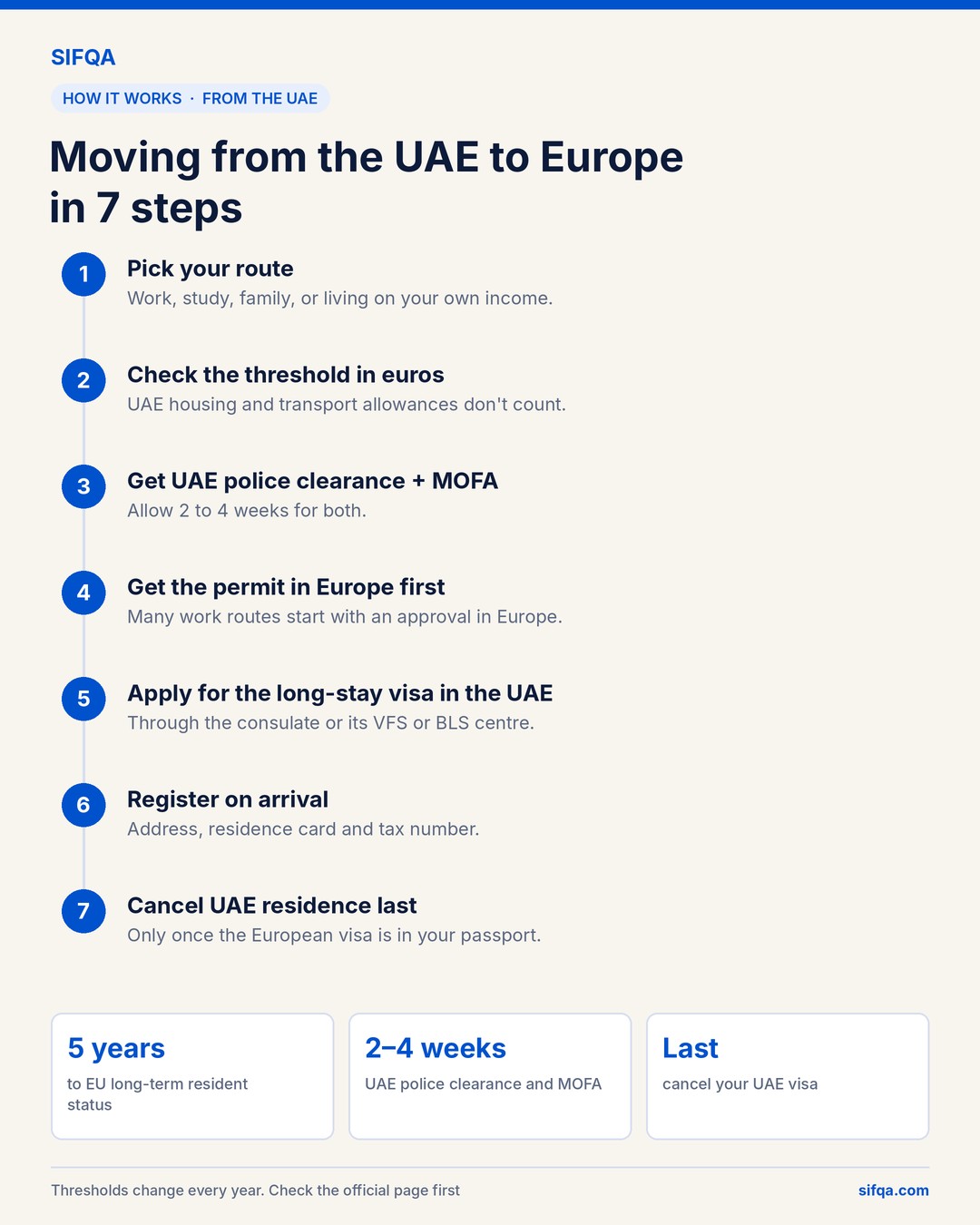
    How to move to Europe from the UAE: step by step

    1. Pick the route that fits your situation. Do you have a job offer, a degree in a shortage field, remote income or passive income? This matters more than the country.
    2. Check the threshold in euros. UAE salaries often include housing and transport allowances. A European permit counts only the gross salary paid by the European employer, or your proven income for self-funded visas.
    3. Prepare UAE documents early. Get a UAE police clearance certificate and, where asked, have it and your degree attested by the UAE Ministry of Foreign Affairs (MOFA). This step alone can take 2 to 4 weeks.
    4. Get the permit or approval in Europe first, if your route needs one. For work routes, the employer (Netherlands) or you or the employer (Ireland) apply in that country. You then apply for the entry visa in the UAE.
    5. Apply for the long-stay visa in the UAE. Book at the consulate or its visa centre (VFS Global or BLS International) for your emirate. Keep your UAE residence valid throughout.
    6. Register on arrival. Every country requires local registration and a residence card within days or weeks of arrival.
    7. Close your UAE life in the right order. Cancel your UAE residence only after the European visa is in your passport. Collect your end-of-service gratuity and close or keep your bank account deliberately.
    Infographic: Moving from the UAE to Europe in 7 steps

    Work routes: Germany, the Netherlands and Ireland

    A work permit is tied to a real job offer from an employer in that country. A UAE employer cannot sponsor you for a European work permit. Each of these three countries has its own guide on Sifqa:

    The United Kingdom is no longer in the EU, but it is still a common move from the UAE. See the UK Skilled Worker visa from the UAE.

    Self-funded and remote-work routes: Portugal and Spain

    These routes do not need a European job, so they suit people who already earn remotely, run a business, own rental property or are retiring.

    • Portugal D7: regular passive income of at least €920 a month, a Portuguese bank account and accommodation in Portugal. The D8 digital nomad visa needs €3,680 a month from remote work. See Portugal D7 and Digital Nomad Visa from the UAE.
    • Spain digital nomad visa: about €2,849 a month in 2026 from an employer or clients mostly outside Spain, with at least three months of prior work for them.
    • Spain non-lucrative visa: €28,800 a year in savings or passive income for the main applicant. Work is not allowed. See Spain digital nomad and non-lucrative visa from the UAE.

    What changes because you apply from the UAE

    IssueWhat to do
    Where you applyAt the consulate or visa centre in the UAE that covers your emirate. Non-Emiratis must show a valid UAE residence permit.
    Police clearanceUsually from the UAE and from your country of nationality. Portugal asks for the UAE certificate to carry a MOFA stamp. See UAE police clearance for immigration.
    DegreeGermany checks recognition; Ireland and the Netherlands mainly look at the job and salary. Keep attested copies ready. See degree assessment from the UAE.
    UAE incomeCounts for Portugal D8 and Spain’s digital nomad visa if your UAE employer lets you work remotely. It does not count for work permits.
    TaxOnce you live in Europe you usually become tax resident there and may be taxed on worldwide income. Get tax advice before you move.
    UAE visa timingDo not cancel your UAE residence before you hold the European visa. See the leaving-the-UAE checklist. If you stay outside the UAE for over six months first, read the six-month rule.

    How long until permanent residence or citizenship?

    Most EU countries grant EU long-term resident status after five years of continuous legal residence. Citizenship takes longer and varies by country. Portugal raised its naturalisation period to 10 years for most nationalities (7 for EU and Portuguese-speaking countries) from 19 May 2026. Ireland’s Critical Skills holders can switch to Stamp 4 after about two years. Years spent living in the UAE do not count towards any of these totals.

    How to avoid relocation scams

    • No real employer sells a job offer. Paying an agent in Dubai for a “European work visa” or “job guarantee” is a warning sign.
    • Check the employer yourself. Dutch employers must appear on the IND’s public register of recognised sponsors. Irish permits are issued by the Department of Enterprise, Tourism and Employment.
    • Pay government fees to the government. Fees go to the authority or its official visa centre, never to a personal account.
    • A Schengen visit visa is not a work visa. Working on a 90-day visa can get you banned from the whole Schengen area.

    Questions people ask

    What is the easiest European country to move to from the UAE?

    With a job offer, Ireland and the Netherlands have the fastest employer-led processes. Without one, Portugal’s D7 has the lowest income requirement at €920 a month in 2026.

    Can I move to Europe from Dubai without a job offer?

    Yes. Germany’s Opportunity Card lets you job-hunt in Germany, and Portugal’s D7 and D8 or Spain’s digital nomad and non-lucrative visas are based on your own income.

    Do I apply in the UAE or in my home country?

    If you legally live in the UAE, you normally apply at the consulate or visa centre in the UAE. Some approvals, such as Dutch and Irish work permits, are first issued inside that country.

    Does my UAE salary count for a European work permit?

    No. Work permits count the salary from the European employer. UAE income only helps for remote-work and self-funded visas.

    Do I need ETIAS to move to Europe?

    No. ETIAS is a future travel authorisation for short visits by visa-exempt nationals and was not yet operating in October 2026. Moving needs a long-stay visa or residence permit.

    Can my family move with me?

    Work-permit holders in the Netherlands and Ireland can usually bring a spouse and children quickly. Portugal now makes most D7 and D8 holders wait before applying for a spouse, although children are exempt.

    Related guides

    Sources

    Written by Asad Waleed M, Dubai. Asad has lived in the UAE for nine years and researches visa rules from government sources. He is not an immigration lawyer or consultant, and Sifqa does not process applications or sell visa services. Read the editorial policy.

    Last checked 4 November 2026. Thresholds change every year, usually on 1 January. Found an error? Email ionicwaleed@gmail.com and it will be fixed and logged.
  • UK Skilled Worker Visa from the UAE (2026): Salary Rules, Costs and Steps

    The UK is still one of the most realistic overseas career moves for professionals in the UAE: English-speaking, a direct flight away, and a clear route to settlement. But the Skilled Worker visa of 2026 is not the visa your colleague got in 2022. Since July 2025 the UK has raised the salary floor, removed most mid-skilled jobs, raised the English level and increased almost every fee. Work visa grants have fallen by more than half from their peak. This guide sets out the current rules, the real cost for a single applicant and a family, and the steps from the UAE.

    Checked on 16 October 2026 against GOV.UK and the latest Home Office statistics. Sources at the end. Rules change often; recheck GOV.UK before you sign a contract.

    On this page

    The short answer

    Requirement2026 rule
    Job offerFrom a UK employer with a sponsor licence
    Skill levelGraduate-level (RQF 6) jobs; lower-skilled only if on the Immigration Salary List or Temporary Shortage List
    Salary£41,700 a year or the job’s going rate, whichever is higher (lower rates for some groups)
    EnglishB2 (upper-intermediate) for new applicants since 8 January 2026
    Application fee from outside the UK£819 (up to 3 years) or £1,618 (over 3 years)
    Health surcharge£1,035 per person per year, paid upfront
    Savings£1,270 for 28 days, unless your employer certifies maintenance
    Decision timeUsually 3 weeks from outside the UK
    SettlementCurrently after 5 years — changes proposed

    Your passport decides, your residence changes the route

    The Skilled Worker visa has the same rules for every nationality. Your passport does not change the salary, skill or fee rules. Where your passport matters:

    • English: nationals of majority English-speaking countries (such as Canada, Australia, New Zealand and the US) are exempt. Indian, Pakistani, Filipino, Egyptian and Nigerian applicants must prove B2, either with an approved test or an English-taught degree confirmed by Ecctis.
    • Tuberculosis test: the UK requires a TB test from people who have lived in certain listed countries for the last six months. The test is based on where you live, not your passport. A Pakistani or Indian national who has lived in the UAE for more than six months is normally assessed by UAE residence.

    Where your UAE residence matters:

    • You apply from the UAE and give biometrics at the UK visa application centre in Dubai or Abu Dhabi.
    • For jobs in education, health and social care, you need a criminal record certificate from every country you have lived in for 12 months or more in the last 10 years — so a UAE police clearance. See our UAE police clearance guide.

    What changed in 2025 and 2026

    DateChange
    22 July 2025Minimum skill level raised to RQF 6 (degree level). General salary threshold raised from £38,700 to £41,700. Overseas recruitment for care workers closed.
    16 December 2025Immigration Skills Charge paid by employers rose 32%.
    8 January 2026English requirement raised from B1 to B2 for new applicants.
    8 April 2026Visa fees increased again (outside-UK fee up to 3 years: £769 → £819).

    People already on the route before these dates often keep older, lower thresholds when they extend. New applicants from the UAE are assessed under the 2026 rules.

    What the numbers show

    The Home Office figures for the year ending June 2026 show how much the route has shrunk:

    Measure (year to June 2026)Figure
    Work visas granted, including dependantsabout 235,000
    Change on previous yeardown 18%
    Change from the peak (year to December 2023)down 62%
    Skilled Worker visas, change from peakdown 48%
    Health and Care Worker visas, change from peakdown 90%
    Work route extensionsabout 731,000 (broadly stable)
    Settlement (ILR) grantsabout 200,000, up 24%

    What this means for you: fewer employers are sponsoring, and those that do are hiring for graduate-level roles paying well above £40,000. Mid-level roles that used to be sponsored — care workers, many technicians, junior admin roles — are mostly gone.

    The salary rules in detail

    You must be paid the higher of:

    • £41,700 a year, or
    • the going rate for your occupation code (each job type has its own rate in the Home Office tables).

    A reduced threshold of £33,400 a year (still subject to going-rate rules) can apply in some cases, such as new entrants under 26 or recent graduates, holders of a relevant PhD, and jobs on the Immigration Salary List. Healthcare and education roles follow national pay scales.

    Example: a software developer’s going rate is above £41,700, so the employer must pay the going rate, not just £41,700. Check your occupation code before negotiating.

    Converting from UAE packages: UK salaries are taxed and do not include housing. £41,700 is about AED 205,000 a year before UK income tax and National Insurance. Compare take-home pay, not headline numbers.

    The English requirement

    Since 8 January 2026, new Skilled Worker applicants need B2. You can prove it with:

    • A Secure English Language Test (SELT) at B2 from an approved provider — for example IELTS for UKVI or PTE Academic UKVI, both available in the UAE. See our IELTS vs PTE vs CELPIP guide.
    • A degree taught in English, confirmed by an Ecctis assessment. See our degree assessment guide.
    • Being a national of an exempt majority English-speaking country.

    Doctors, dentists, nurses and midwives who passed an English assessment accepted by their UK regulator do not need a separate test.

    What it really costs

    Costs you pay

    Item3-year visa5-year visa
    Application fee (outside UK)£819£1,618
    Immigration Health Surcharge (£1,035 × years)£3,105£5,175
    Total per adult£3,924£6,793

    A family of four on a 5-year visa (two adults, two children): each person pays the application fee and the health surcharge. Using the adult figures for everyone, that is about £27,000 before flights, English tests and documents. Children’s fees and surcharge rates can differ slightly — use the GOV.UK calculator for your family.

    You also need £1,270 in savings for 28 days (plus more for dependants) unless your employer certifies maintenance on your Certificate of Sponsorship.

    Costs the employer pays (and must not pass to you)

    ItemAmount
    Certificate of Sponsorship£525 per certificate
    Immigration Skills Charge (medium/large sponsor)£1,320 for the first year, £660 per extra six months
    Immigration Skills Charge (small sponsor or charity)£480 for the first year, £240 per extra six months

    The Immigration Skills Charge cannot legally be recovered from the worker. If an employer or agent asks you to pay for your sponsorship, treat it as a warning sign.

    How to apply from the UAE step by step

    1. Find a sponsored job. Check the employer is on the Home Office “Register of licensed sponsors” (published on GOV.UK).
    2. Check the job: its occupation code, skill level and going rate.
    3. Get your English proof ready (B2 test or Ecctis).
    4. Receive your Certificate of Sponsorship (CoS) reference number from the employer.
    5. Gather documents: passport, CoS number, English proof, TB certificate if needed, criminal record certificate if your job requires it, bank statements if your employer does not certify maintenance, and relationship documents for dependants.
    6. Apply online on GOV.UK within 3 months of receiving your CoS. You can apply up to 3 months before your start date.
    7. Pay the application fee and health surcharge.
    8. Give biometrics at the UK visa application centre in Dubai or Abu Dhabi, or use the UK ID Check app if eligible.
    9. Wait for the decision — usually 3 weeks. Priority services may be offered.
    10. Collect your eVisa. The UK now issues digital status instead of a vignette for most applicants; follow the instructions in your decision email.

    The route to settlement (ILR)

    Today, Skilled Workers can usually apply for indefinite leave to remain after 5 years. The UK government has proposed an “earned settlement” model that would extend the standard wait to 10 years for many workers, with reductions for higher earners and other contributions. Read our UK ILR and earned settlement guide for what is confirmed and what is still only proposed.

    Job and sponsorship scams aimed at UAE residents

    The fall in sponsored jobs has created a market in fake offers. Common signs:

    • You are asked to pay for a CoS, a “work permit” or a “sponsorship fee”.
    • The employer is not on the GOV.UK register of licensed sponsors.
    • The salary is below £41,700 for a role that is not on a shortage list.
    • An agent guarantees approval.

    Real UK employers pay their own sponsorship costs. Your only payments are the visa fee, health surcharge and your own documents.

    Mistakes to avoid

    • Accepting a job without checking the going rate for its occupation code.
    • Taking a B1-level test. New applicants need B2.
    • Forgetting the UAE police clearance for health, education and care roles.
    • Comparing a UAE tax-free salary with a UK gross salary.
    • Paying any person or company for sponsorship.

    Questions people ask

    What is the minimum salary for a UK Skilled Worker visa in 2026?

    £41,700 a year or the going rate for the job, whichever is higher. Some applicants qualify at £33,400.

    Can I get a UK Skilled Worker visa without a degree?

    The job must usually be at degree level (RQF 6), but you do not always personally need a degree. Lower-skilled jobs only qualify if they are on the Immigration Salary List or Temporary Shortage List.

    How much does a UK Skilled Worker visa cost from Dubai?

    For one adult on a 5-year visa: £1,618 application fee plus £5,175 health surcharge, about £6,793. Your employer pays the sponsorship and Immigration Skills Charge.

    How long does it take from the UAE?

    Usually about 3 weeks after biometrics.

    Do I need a UAE police clearance certificate?

    Yes if your job is in education, health or social care and you have lived in the UAE for 12 months or more in the last 10 years.

    Can I bring my family?

    Yes. Your partner and children can apply as dependants. Each pays the application fee and health surcharge.

    Related guides

    Sources

    • GOV.UK — Skilled Worker visa: gov.uk
    • GOV.UK — Skilled Worker visa: your job (salary rules): gov.uk
    • GOV.UK — Skilled Worker visa: knowledge of English: gov.uk
    • GOV.UK — Skilled Worker visa: how much it costs: gov.uk
    • Home Office immigration statistics, year ending June 2026, as reported by Personnel Today
    • Davidson Morris — Immigration Skills Charge increase from 16 December 2025

    Written by Asad Waleed M, Dubai. Asad has lived in the UAE for nine years and researches visa rules from government sources. He is not an immigration lawyer or consultant, and Sifqa does not process applications. Read the editorial policy.

    Last checked 16 October 2026. Rechecked every April (fee changes) and whenever the Immigration Rules change. Found an error? Email ionicwaleed@gmail.com — it gets fixed and logged.

  • New Zealand Skilled Migrant Residence from the UAE (2026): Points, Pay and Pathways

    New Zealand is a serious option for UAE families who want permanent residence in an English-speaking country with a smaller, slower pace of life. But it works very differently from Canada’s Express Entry or Australia’s 189 visa. There is no pool you can enter from Dubai on qualifications alone. Almost every New Zealand residence route starts with a New Zealand job offer. This guide explains the Skilled Migrant Category (SMC) as it works after the changes of 24 August 2026, with the actual wage figures, and shows which UAE residents can go straight to residence and which need a work visa first.

    Checked on 16 October 2026 against Immigration New Zealand (INZ). Sources at the end.

    On this page

    The short answer

    QuestionAnswer
    Main routeSkilled Migrant Category (SMC) resident visa
    Job needed?Yes — a job or offer in New Zealand, usually with an accredited employer
    PathwaysPoints-based (6 points), Skilled Work Experience, Trades and Technician (new from 24 August 2026)
    Median wage (from 9 March 2026)NZ$35.00 an hour
    Age limit55 or under
    EnglishIELTS 6.5 overall or equivalent (principal applicant)
    Expression of Interest feeNone
    Residence visa feeFrom about NZ$6,450

    Your passport decides, your residence changes the route

    The SMC rules are the same for every nationality. Your passport does not give you extra points. What your passport affects:

    • English: applicants from some English-speaking countries can meet the requirement in other ways; most UAE expats will take a test.
    • Visitor visa to attend interviews: Indian, Pakistani, Filipino and other passports need a New Zealand visitor visa; UK and many EU passports use an NZeTA.

    What your UAE residence affects:

    • Police certificates: you need one from every country you have lived in for 5 years or more since age 17 — for many readers, that includes the UAE. See our UAE police clearance guide.
    • Medicals: done with an INZ panel physician in the UAE. See our immigration medical guide.
    • Work experience in the UAE counts as “relevant work experience” for the new pathways, but New Zealand work experience is a separate requirement for most applicants.

    The wage figures that decide everything

    Most SMC rules are tied to New Zealand’s median wage, updated each year. From 9 March 2026 the median wage used by INZ is NZ$35.00 an hour (up from NZ$33.56).

    MultipleHourlyAnnual (40 hrs × 52 weeks)Used for
    1 × medianNZ$35.00NZ$72,800Trades and Technician pathway; skilled NZ work
    1.1 × medianNZ$38.50NZ$80,080Skilled Work Experience pathway
    1.5 × medianNZ$52.50NZ$109,2003 income points
    2 × medianNZ$70.00NZ$145,6004 income points
    3 × medianNZ$105.00NZ$218,4006 income points

    NZ$72,800 is about AED 160,000 a year before New Zealand income tax.

    Under the August 2026 changes, the threshold you must meet is generally the one in force when you started your skilled work experience, so you are less likely to be caught out by a mid-year increase.

    The three SMC pathways

    1. Points-based pathway

    You need 6 points from one skill category — you cannot mix categories — plus New Zealand work experience points if you need them.

    CategoryHow points are earned
    QualificationsRecognised doctorate or qualifying NZ master’s: 6. NZ bachelor’s: 5. Overseas bachelor’s at level 7: 4 under the 2026 rules (previously 3).
    Occupational registrationNZ registration needing years of training or experience — the longer the training, the more points (up to 6).
    Income3 points at 1.5× median, 4 at 2× median, 6 at 3× median.
    NZ skilled work experienceUp to 3 extra points; under the 2026 rules, 3 points for 2 years within the last 4 years.

    New from 24 August 2026: accountants who can do Qualified Statutory Accountant work in New Zealand and hold CPA Australia membership can claim 6 points.

    Example: an engineer from Dubai with an overseas bachelor’s (4 points) needs 2 more points. Those come from New Zealand work experience. So she normally works in New Zealand on a work visa first.

    2. Skilled Work Experience pathway (new)

    • Job or offer in an ANZSCO skill level 1–3 occupation paid at least 1.1 × median.
    • At least 3 years of relevant skilled work experience (this can be in the UAE).
    • Plus 2 years of skilled work in New Zealand at 1.1 × median.
    • Amber List jobs have extra requirements; Red List jobs are excluded. Self-employment does not count.

    3. Trades and Technician pathway (new)

    • Eligible trade or technician occupation paid at least the median wage.
    • Relevant qualification at level 4 or higher. Overseas qualifications need an International Qualification Assessment (IQA) from NZQA.
    • At least 2.5 years of post-qualification work experience.
    • Plus 1.5 years of skilled work in New Zealand at the median wage.

    Can you go straight from the UAE to residence?

    Your profileDirect to SMC?
    PhD holder with an NZ job offerPossibly — doctorate gives 6 points
    NZ-registered doctor with a job offerPossibly — registration points
    Job offer paying NZ$105+ an hourPossibly — 6 income points
    Engineer, accountant, IT professional with a bachelor’sUsually work visa first, then SMC
    Electrician, plumber, technicianWork visa first, then Trades and Technician pathway

    Separately, some occupations on New Zealand’s Green List lead to residence on their own track (“Straight to Residence” or “Work to Residence”). If your job is on it, check that route first.

    Step by step from the UAE

    1. Check your occupation on ANZSCO and the Green List.
    2. Get your qualification assessed if needed (NZQA IQA). See our degree assessment guide.
    3. Take an English test (IELTS 6.5 or equivalent). See our test comparison.
    4. Find a job with an INZ-accredited employer.
    5. Move on an Accredited Employer Work Visa (AEWV) if you cannot go direct.
    6. Build New Zealand work experience at the required wage.
    7. Submit an Expression of Interest (EOI) — free.
    8. Receive an invitation to apply.
    9. Lodge the residence application with police certificates, medicals and evidence.
    10. Receive your resident visa. After two years of meeting conditions, apply for a permanent resident visa.

    Costs

    ItemApproximate cost
    Expression of InterestFree
    SMC resident visafrom NZ$6,450
    IELTS in the UAEAED 1,590–1,750
    NZQA International Qualification AssessmentVaries by qualification
    Medical examinationSet by the clinic
    UAE police clearanceSee our police clearance guide
    AEWV (if needed first)Separate fee

    Processing times

    INZ publishes processing times weekly. Third-party summaries in September 2026 reported most SMC applications being decided within about four months. Times depend heavily on how complete your file is.

    Mistakes to avoid

    • Assuming you can apply from Dubai without a job offer. You cannot for SMC.
    • Mixing point categories (for example qualification points plus income points). Not allowed.
    • Accepting an NZ job below the wage threshold you will need for residence.
    • Ignoring the age limit — you must be 55 or under.
    • Letting your English test expire before you are invited (usually valid 2 years).

    Questions people ask

    Can I apply for New Zealand PR from Dubai without a job offer?

    Not through the Skilled Migrant Category. All SMC pathways need a job or offer in New Zealand.

    What is the New Zealand median wage for immigration in 2026?

    NZ$35.00 an hour from 9 March 2026, about NZ$72,800 a year for full-time work.

    How many points do I need?

    Six, from one category: qualifications, occupational registration or income, plus New Zealand work experience points if needed.

    Does UAE work experience count?

    Yes as relevant work experience for the new pathways. Most applicants also need New Zealand work experience.

    What is the age limit?

    55 or under.

    Is there an IELTS requirement?

    Yes. The principal applicant usually needs IELTS 6.5 overall or an accepted equivalent.

    Related guides

    Sources

    • Immigration New Zealand — Skilled Migrant Category pathway to residence: immigration.govt.nz
    • Immigration New Zealand — 2026 changes to the SMC resident visa: immigration.govt.nz
    • Immigration New Zealand — the SMC wage threshold: immigration.govt.nz
    • Visa Atlas — SMC summary (reviewed 10 September 2026)
    • Visa Matters — NZ immigration wage thresholds 2026

    Written by Asad Waleed M, Dubai. Asad has lived in the UAE for nine years and researches visa rules from government sources. He is not an immigration lawyer or consultant, and Sifqa does not process applications. Read the editorial policy.

    Last checked 16 October 2026. Rechecked every March (wage threshold update) and when Immigration New Zealand changes SMC instructions. Found an error? Email ionicwaleed@gmail.com — it gets fixed and logged.

  • Canada Study Permit from the UAE (2026): Caps, PAL, Proof of Funds and Refusal Rates

    Canada used to be the default study destination for families in the UAE. In 2026 it is a much harder door. Canada has cut new study permits to about 155,000 for the year — roughly half of 2025 — closed the fast-track Student Direct Stream, raised the money you must show, and is refusing a very large share of applications, especially from India. Getting in is still possible, but only with a file built for the new rules. This guide gives you the numbers, the requirements and the steps from the UAE.

    Checked on 16 October 2026 against IRCC and published IRCC data. Sources at the end.

    On this page

    The short answer

    Item2026 rule
    Letter of acceptanceFrom a Designated Learning Institution (DLI)
    Provincial attestation letter (PAL/TAL)Required for most college and bachelor’s programs; master’s and PhD at public institutions exempt since 1 January 2026
    Proof of funds (single, outside Quebec)CA$22,895 for living costs, plus first-year tuition and travel
    Application feeCA$150 + CA$85 biometrics
    Where you apply from the UAEOnline, with biometrics at the Canada visa application centre (VFS) in Dubai or Abu Dhabi
    Off-campus workUp to 24 hours a week during studies
    Spouse work permitOnly for master’s of 16+ months, PhD and some professional programs

    The numbers you should know

    MeasureFigure
    New study permit arrivals planned for 2026about 155,000 (about 305,900 in 2025)
    Applications accepted under the 2026 PAL/TAL cap309,670
    New study permits approved in 2024267,890 (down 48% from 2023)
    Overall study permit refusal rate, August 2025about 40%
    Indian applicants’ refusal rate, August 2025about 74% (32% in August 2023)
    Chinese applicants’ refusal rate, August 202524%
    Monthly Indian applications, August 2023 → August 202520,900 → 4,515

    Sources: IRCC data reported by Reuters/Gulf News, ICEF Monitor and SiLaw. Figures mix IRCC planning levels and decision data — they show the direction clearly even where definitions differ.

    What this means: a refusal is now the most likely outcome for weak files. IRCC officers focus on where your money came from, whether your study plan makes sense for your career, and whether you will leave Canada when your studies end.

    Your passport decides, your residence changes the route

    Your passport affects how hard IRCC looks at your file. Refusal rates vary sharply by nationality — about 74% for Indian applicants in August 2025 against 24% for Chinese applicants. Processing times also differ: published 2026 estimates were about 8–12 weeks for India, about 8 weeks for Pakistan, 6–10 weeks for the Philippines and 12–16 weeks for Nigeria.

    Your UAE residence changes how you apply and how you prove your ties:

    • You apply online as a resident of the UAE and give biometrics at the Canada visa application centre in Dubai or Abu Dhabi.
    • If your parents fund your studies from UAE salaries, IRCC will want UAE bank statements, salary certificates and the history of the money — not just a final balance.
    • Your plan to return matters. For many UAE-raised students, “home” is the UAE where parents live, but your residence depends on your sponsor’s visa. Explain this clearly in your study plan.
    • If you have lived in a country designated by IRCC for medical reasons for 6 months in the past year, you may need an immigration medical exam. See our medical exam guide.

    The PAL/TAL and the cap

    Most new students need a provincial or territorial attestation letter (PAL/TAL) from the province where they will study. Your school usually requests it for you after you accept the offer. Each province has a fixed number of letters; Ontario’s 2026 allocation was the largest (104,780 application spaces).

    You do not need a PAL/TAL if:

    • You are a master’s or PhD student at a public institution (since 1 January 2026).
    • You are in primary or secondary school.
    • You are extending a permit at the same institution and level.

    Private-college master’s programs still need one. In Quebec, you need a CAQ from the Quebec government instead.

    Proof of funds: the rule that refuses most files

    You must show money for first-year tuition + travel + living costs. The living-cost minimum (outside Quebec, from 1 September 2025):

    Family sizeLiving costs required
    1 (student only)CA$22,895
    2CA$28,502
    3CA$35,040
    4CA$42,543
    Each extra person+CA$6,170

    Example: a single student with tuition of CA$25,000 must show about CA$47,900 plus airfare. At about AED 2.7 per Canadian dollar, that is roughly AED 130,000.

    How UAE families should document money

    • Bank statements for 4–6 months showing steady balances, stamped by the bank. See our UAE bank statement guide.
    • Salary certificates and payslips for the sponsoring parent(s).
    • Explanation of large deposits — gratuity, property sale, investment maturity — with documents.
    • A Guaranteed Investment Certificate (GIC) from a participating Canadian bank is strong evidence for living costs.
    • Proof of tuition already paid reduces the amount you must show.

    Money that appears suddenly, with no source, is one of the most common refusal reasons.

    Fees

    ItemCost
    Study permit applicationCA$150
    BiometricsCA$85 (CA$170 maximum for a family)
    Quebec CAQ (if studying in Quebec)CA$135
    VFS service chargesSet by VFS in AED
    Medical exam (if required)Set by the panel clinic

    Step by step from the UAE

    1. Choose a DLI program that fits your previous studies and career plan. Check it is eligible for a post-graduation work permit (PGWP) if you want to work after.
    2. Take an English test accepted by your school (IELTS Academic, PTE Academic, etc.).
    3. Get your letter of acceptance and pay the deposit.
    4. Get your PAL/TAL through the school (unless exempt).
    5. Prepare funds evidence and source-of-funds documents.
    6. Write a study plan: why this program, why Canada, why not the UAE or your home country, and what you will do after.
    7. Apply online in your IRCC account. Upload passport, letter of acceptance, PAL/TAL, funds, study plan, UAE residence visa and Emirates ID.
    8. Pay CA$150 + CA$85 and book biometrics at VFS in Dubai or Abu Dhabi.
    9. Complete a medical exam if IRCC asks.
    10. Receive your decision. If approved, you get a letter of introduction and a visitor visa (or eTA) to travel; the study permit is issued at the Canadian border.

    Work and family rules

    • Work during studies: up to 24 hours a week off campus during academic sessions.
    • PGWP after graduation: requires an eligible program of at least 8 months. Since November 2024, graduates need CLB 7 (university) or CLB 5 (college) in English or French. Non-degree programs must be in an eligible field of study. Master’s graduates usually get up to 3 years.
    • Spouses: an open work permit is only available if you study a master’s of 16+ months, a PhD or certain professional programs. Spouses of undergraduate and college students no longer qualify.

    If you are refused

    Read the officer’s notes (request them through GCMS notes if the letter is vague). Common reasons are funds, study plan, ties and purpose of visit. You can reapply with a stronger file, or seek judicial review in the Federal Court within strict time limits — this needs a Canadian lawyer.

    Mistakes to avoid

    • Choosing a program unrelated to your previous studies or job without explaining why.
    • Showing a large balance without a source.
    • Assuming a PAL is not needed for a private-college master’s.
    • Using an agent who writes a generic study plan.
    • Applying late — IRCC processing and provincial caps can run out.

    Questions people ask

    How much money do I need for a Canadian study permit from the UAE?

    CA$22,895 for living costs (single student, outside Quebec) plus first-year tuition and travel.

    Do I need a PAL for a master’s degree?

    Not if it is at a public institution — master’s and PhD students at public DLIs have been exempt since 1 January 2026. Private institutions still require one.

    Can I apply for a Canadian study permit from Dubai?

    Yes. Apply online and give biometrics at the Canada visa application centre in Dubai or Abu Dhabi.

    Why are so many Indian students refused?

    IRCC data showed an Indian refusal rate of about 74% in August 2025, linked to fraud concerns and stricter checks on funds and study plans. Strong, well-documented files are still approved.

    Is the Student Direct Stream still open?

    No. SDS closed on 8 November 2024. All students apply through the regular stream.

    Can my spouse work in Canada while I study?

    Only if you are in a master’s program of at least 16 months, a PhD or an eligible professional program.

    Related guides

    Sources

    • IRCC — Study permit: who can apply and how: canada.ca
    • IRCC — Proof of financial support for study permits: canada.ca
    • IRCC — Provincial or territorial attestation letter: canada.ca
    • SiLaw — Canada study permits 2026 guide (cap, funds and approval figures), May 2026
    • Gulf News / Reuters — Canada study permit refusal rates, August 2025 data
    • Moving2Canada / ICEF Monitor — study permit approvals 2023–2025

    Written by Asad Waleed M, Dubai. Asad has lived in the UAE for nine years and researches visa rules from government sources. He is not an immigration lawyer or consultant, and Sifqa does not process applications. Read the editorial policy.

    Last checked 16 October 2026. Rechecked quarterly and when IRCC announces new cap or funds figures. Found an error? Email ionicwaleed@gmail.com — it gets fixed and logged.

  • UK Student Visa from the UAE (2026): Fees, Funds, CAS and the New Graduate Route

    For families in Dubai and Abu Dhabi, the UK is still the first choice for university: familiar curriculum, many UAE schools following British exams, a seven-hour flight and a well-known route to work afterwards. But the UK Student visa changed again in 2026. The money you must show has risen, the visa fee has risen, the visa is now fully digital, and the Graduate Route will be cut to 18 months for applications from January 2027. This guide gives you the 2026 figures and the steps from the UAE.

    Checked on 16 October 2026 against GOV.UK and the latest Home Office statistics. Sources at the end.

    On this page

    The short answer

    Item2026 rule
    OfferConfirmation of Acceptance for Studies (CAS) from a licensed student sponsor
    Visa fee (outside UK)£558 (raised from £524)
    Health surcharge£776 per year of visa
    Living costs — London£1,529 a month, up to 9 months (£13,761)
    Living costs — outside London£1,171 a month, up to 9 months (£10,539)
    EnglishUsually B2 for degree-level study (university or SELT evidence)
    DependantsOnly for postgraduate research (PhD and research master’s) or government-sponsored students
    DecisionUsually within 3 weeks from outside the UK
    After graduationGraduate visa: 2 years (applications to 31 Dec 2026), 18 months from 1 Jan 2027; 3 years for PhD

    The numbers

    Measure (year to June 2026)Figure
    Sponsored study visas granted (including dependants)383,000, down 11%
    Main applicants366,000, down 12%
    Below the peak (year to June 2023)41% lower
    Top nationalitiesChina (86,000) and India (83,000) — 46% of main applicants

    Source: Home Office statistics as reported by Personnel Today. Fewer students are coming, but the UK is still issuing well over 350,000 student visas a year — it remains far more open than Canada.

    Your passport decides, your residence changes the route

    The Student visa rules are the same for every nationality. Your passport matters in a few places:

    • Differentiation arrangements: nationals of some low-risk countries may not need to submit financial and qualification documents with the application (though they must still meet the rules). Most South Asian passports are not on this list.
    • English: majority English-speaking nationals are exempt from proving English.
    • ATAS: students of certain sensitive science and engineering subjects need an ATAS certificate, depending on nationality.

    Your UAE residence changes:

    • Where you apply: online from the UAE, with biometrics at the UK visa application centre in Dubai or Abu Dhabi.
    • TB test: UK TB testing depends on where you have lived for the last 6 months, not your passport. The UAE is not on the UK list, so an Indian or Pakistani student who has lived in the UAE for 6+ months is normally assessed as a UAE resident.
    • Funds: UAE bank accounts in a parent’s name are acceptable with a birth certificate and a parental consent letter.

    The money you must show

    You must show course fees for the first year (minus any deposit paid) plus living costs for up to 9 months:

    LocationPer month9-month total
    London£1,529£13,761
    Outside London£1,171£10,539

    Example: a student going to Manchester with £22,000 tuition, having paid a £5,000 deposit, shows £17,000 + £10,539 = £27,539 — about AED 136,000.

    The money must be held continuously for the required period, ending within 31 days of your application. A single day below the amount can lead to refusal. Reports in August 2026 said the holding period was reduced from 28 to 14 days; until GOV.UK confirms this for your application date, hold the money for 28 days to be safe.

    UAE bank statement tips

    • Statements must show your name (or a parent’s), account number, bank name, and the balance on each day of the holding period.
    • Online printouts must usually be stamped by the bank or accompanied by a bank letter.
    • Funds in AED are accepted — UKVI converts them at the OANDA rate on your application date. Leave a margin for exchange-rate movement.

    See our UAE bank statement guide.

    Total visa costs

    Item3-year degree (visa about 3 years 4 months)
    Visa fee£558
    Health surcharge (£776 × years, part-years rounded)about £2,716
    IELTS for UKVI (if needed)AED 1,680
    TB testNot normally needed for UAE residents

    These are visa costs only — tuition for international students typically ranges from about £15,000 to over £35,000 a year.

    Step by step from the UAE

    1. Get an unconditional offer and accept it.
    2. Pay your deposit and receive your CAS number.
    3. Hold the funds for the required period.
    4. Prepare documents: passport, CAS, evidence of qualifications listed on the CAS, funds evidence, parental consent (if under 18 or using parents’ funds), ATAS if required.
    5. Apply online on GOV.UK up to 6 months before your course starts.
    6. Pay the visa fee and health surcharge.
    7. Give biometrics in Dubai or Abu Dhabi, or use the UK ID Check app if eligible.
    8. Receive your decision — usually within 3 weeks.
    9. Set up your UKVI account. Since 2026 the UK issues an eVisa, not a sticker or BRP. You prove your status online with a share code.

    Working and family

    • Work during term: up to 20 hours a week for degree-level students; full time during official vacations.
    • Dependants: since January 2024, only students on postgraduate research programs (or government-sponsored courses of 6+ months) can bring a partner or children.
    • Switching: you can switch to a Skilled Worker visa inside the UK after completing your course, if you meet the job and salary rules. See our Skilled Worker guide.

    The Graduate Route: 2 years or 18 months?

    After a UK degree, the Graduate visa lets you work in any job without sponsorship:

    When you apply for the Graduate visaLength
    On or before 31 December 20262 years (3 years for PhD)
    From 1 January 202718 months for bachelor’s and master’s (3 years for PhD)

    Students starting a 3-year bachelor’s in September 2026 will graduate in 2029, so they should plan on 18 months.

    Mistakes to avoid

    • Funds dipping below the required amount for even one day.
    • Using a statement dated more than 31 days before your application.
    • Applying before your CAS details (course, fees, qualifications) are correct.
    • Assuming a partner can join you on a taught master’s. They cannot.
    • Planning a career on a 2-year Graduate Route that will be 18 months by the time you graduate.

    Questions people ask

    How much bank balance do I need for a UK student visa from Dubai?

    First-year tuition (minus deposits paid) plus £1,529 a month for London or £1,171 a month elsewhere, for up to 9 months.

    How much is the UK student visa fee in 2026?

    £558 from outside the UK, plus the health surcharge of £776 per year.

    Can I use my father’s UAE bank account?

    Yes, with your birth certificate and a letter of consent from your parent.

    Can my wife come with me on a UK master’s?

    Only if it is a research master’s or PhD, or a government-sponsored course of 6 months or more.

    How long is the UK Graduate visa now?

    Two years for applications made by 31 December 2026; 18 months for bachelor’s and master’s graduates applying from 1 January 2027. PhD graduates get 3 years.

    Do I still get a BRP?

    No. The UK now issues digital eVisas, managed through a UKVI account.

    Related guides

    Sources

    • GOV.UK — Student visa: gov.uk
    • GOV.UK — Student visa: money you need: gov.uk
    • GOV.UK — Graduate visa: gov.uk
    • Home Office immigration statistics, year ending June 2026, as reported by Personnel Today
    • Visas Update — UK student visa changes 2026, August 2026
    • Bankfield Heath — UK fees from 8 April 2026

    Written by Asad Waleed M, Dubai. Asad has lived in the UAE for nine years and researches visa rules from government sources. He is not an immigration lawyer or consultant, and Sifqa does not process applications. Read the editorial policy.

    Last checked 16 October 2026. Rechecked every April (fee changes) and when UKVI updates the Student route. Found an error? Email ionicwaleed@gmail.com — it gets fixed and logged.

  • Australia Student Visa from the UAE (2026): Subclass 500 Fees, Funds and the Genuine Student Test

    Australia remains a strong study option for UAE families — good universities, a large South Asian and Arab community, generous work rights and a clear path from study to skilled migration. But it now has the highest student visa application fee of the major destinations (A$2,500 from 1 July 2026), it limits new international student places, and every applicant must pass the Genuine Student test in writing. This guide explains what UAE residents need, what it costs, and how your passport changes the paperwork.

    Checked on 16 October 2026 against the Department of Home Affairs and published fee changes. Sources at the end.

    On this page

    The short answer

    Item2026 rule
    VisaStudent visa (subclass 500)
    Visa feeA$2,500 for most applicants from 1 July 2026 (A$2,000 before)
    EnrolmentConfirmation of Enrolment (CoE) from a registered provider
    Living costs to showA$29,710 for 12 months (student), plus tuition and travel
    Genuine Student testWritten answers on why you chose the course, provider and Australia
    EnglishCommonly IELTS 6.0 overall (or equivalent) for degree study; providers may ask more
    Health insuranceOverseas Student Health Cover (OSHC) for the whole stay
    WorkUp to 48 hours per fortnight in term, unlimited in breaks
    After studyTemporary Graduate visa (subclass 485) — fee A$5,750 from 1 July 2026

    The numbers

    MeasureFigure
    Student visa fee, 2023A$710
    Student visa fee, July 2024A$1,600
    Student visa fee, July 2025A$2,000
    Student visa fee, July 2026A$2,500
    485 graduate visa fee from 1 July 2026A$5,750 (A$4,600 before)
    National Planning Level for new international students (2026)about 295,000 places

    The fee has more than tripled in three years. Combined with the planning level, Australia now prioritises fewer, better-prepared students — which favours well-documented UAE applicants.

    Your passport decides, your residence changes the route

    Your passport sets your evidence level. Home Affairs combines your country of citizenship with your education provider’s risk rating to decide how much evidence of money and English you must upload:

    • Evidence level 1–2: often no financial or English evidence needed up front (but you must still meet the rules).
    • Evidence level 3: full financial and English evidence required. India was reported as moved to level 3 in April 2026, along with Nepal and Bhutan.

    Use the official Document Checklist Tool with your passport and provider to see exactly what you must upload.

    Your UAE residence changes:

    • Where you apply: online through ImmiAccount from the UAE; biometrics at the Australia visa application centre if requested.
    • Health exams: done with an approved panel clinic in the UAE if requested. See our medical exam guide.
    • Genuine Student answers: must explain your circumstances in the UAE and your home country — for example, a student raised in Dubai whose parents are sponsored residents.

    The Genuine Student test

    Since March 2024, the Genuine Student (GS) requirement replaced the older GTE statement. In the application you answer specific questions (each up to about 150 words):

    1. Your current circumstances — family, community, employment, finances.
    2. Why you want to study this course with this provider.
    3. How the course will benefit your future.
    4. Your immigration history, including previous refusals.
    5. For school-age or family situations, any other relevant information.

    What officers look for: a logical link between your previous studies, the course and your career; knowledge of the course content; and a realistic plan. Generic answers copied from agents are easy to spot.

    Money you must show

    For a 12-month period you must show:

    ItemAmount
    Living costs (student)A$29,710
    Living costs (partner)additional amount set by Home Affairs
    Living costs (each child)additional amount set by Home Affairs
    TuitionFirst-year fees (minus amounts paid)
    TravelReasonable return airfare

    Example: a single student with A$40,000 tuition, A$10,000 already paid, shows A$30,000 + A$29,710 + about A$2,000 travel = about A$61,700 — roughly AED 150,000.

    Alternatively, some applicants can show a parent’s or partner’s annual income above a set threshold instead of savings. See our UAE bank statement guide for documenting UAE funds.

    Step by step from the UAE

    1. Choose a course and provider registered on CRICOS.
    2. Take an English test at a test centre (at-home tests are not accepted). See our test comparison.
    3. Accept the offer, pay the deposit and buy OSHC.
    4. Receive your CoE.
    5. Check your evidence level in the Document Checklist Tool.
    6. Create an ImmiAccount and complete the subclass 500 application, including the Genuine Student answers.
    7. Upload passport, CoE, OSHC, English results, funds and any relationship documents.
    8. Pay A$2,500.
    9. Biometrics and health checks if requested.
    10. Receive your decision by email. The grant letter lists your conditions.

    Published estimates for offshore processing range from a few weeks for priority-sector applications to 8–14+ weeks for higher-risk files. Apply at least 3 months before your course starts.

    Work, family and after graduation

    • Work: up to 48 hours per fortnight during study periods; unlimited during scheduled course breaks.
    • Family: partners and children can be included, with extra funds and their own fees.
    • After graduation: the Temporary Graduate visa (subclass 485) — now A$5,750 — gives post-study work rights, after which some graduates move to skilled visas. See our Australia PR guide.

    Mistakes to avoid

    • Generic Genuine Student answers that could apply to anyone.
    • Choosing a lower-level course than your previous qualification without a strong reason.
    • Using an at-home English test.
    • Forgetting OSHC for the whole visa period.
    • Undeclared previous refusals for any country.

    Questions people ask

    How much is the Australian student visa fee in 2026?

    A$2,500 for most applicants who lodge on or after 1 July 2026.

    How much money do I need to show?

    A$29,710 for 12 months of living costs, plus tuition and travel. Your evidence level decides whether you must upload proof.

    What IELTS score do I need?

    Often 6.0 overall for degree study, but your university may require more. At-home tests are not accepted.

    Can I work while studying in Australia?

    Yes, up to 48 hours per fortnight during term and unlimited during breaks.

    What is the Genuine Student requirement?

    A set of written questions in the application about your circumstances, why you chose the course and provider, and how the course helps your future.

    Related guides

    Sources

    • Department of Home Affairs — Student visa (subclass 500): immi.homeaffairs.gov.au
    • Department of Home Affairs — Genuine Student requirement: immi.homeaffairs.gov.au
    • Department of Home Affairs — Document Checklist Tool (evidence levels): immi.homeaffairs.gov.au
    • IDP — Australia student and 485 visa fee changes from 1 July 2026
    • AECC Global — Australia student visa 2026 (National Planning Level, evidence levels), September 2026

    Written by Asad Waleed M, Dubai. Asad has lived in the UAE for nine years and researches visa rules from government sources. He is not an immigration lawyer or consultant, and Sifqa does not process applications. Read the editorial policy.

    Last checked 16 October 2026. Rechecked every July (fee indexation) and when Home Affairs changes student visa settings. Found an error? Email ionicwaleed@gmail.com — it gets fixed and logged.

  • Germany Opportunity Card and EU Blue Card from the UAE (2026 Guide)

    Germany is one of the few countries where you can move without a job offer and look for work once you arrive. The Opportunity Card (Chancenkarte) gives you up to 12 months to find a job. Once you have one, the EU Blue Card or a skilled worker permit lets you stay, and the Blue Card can lead to permanent residence in as little as 21 months. This guide explains each route, the 2026 figures, and how to apply from the UAE, where all applications go through the German Consulate General in Dubai.

    Checked on 5 October 2026 against the German Consulate General in Dubai, the Federal Employment Agency and German government sources. Sources are listed at the end. Salary thresholds change every January, so confirm the current figures before you apply.

    On this page

    Which route fits you

    Your situationBest route
    Degree or vocational qualification, no job offer yetOpportunity Card, then switch to a work permit in Germany
    University degree and a German job offer paying at least €50,700 a year (or €45,934.20 in shortage jobs)EU Blue Card
    Recognised degree or vocational qualification and a job offer below the Blue Card salarySkilled worker visa
    At least 2 years’ experience, a qualification recognised in your home country, and a job offer paying at least €45,630Experienced professional route
    IT specialist without a degree, with 3 years’ experience and a job offerEU Blue Card through the IT specialist rule

    The Opportunity Card replaced the old job seeker visa for skilled workers. It is the only route on this list that does not need a job offer before you go.

    What your passport decides and what your UAE residence changes

    Decided byWhat it affects
    Your passportAlmost nothing for eligibility: the same rules apply to Indian, Pakistani, Filipino, Egyptian and other nationals. Citizens of a few countries, including the US, UK, Canada and Australia, can enter Germany first and apply for the permit there.
    Your UAE residenceWhere you apply. UAE residents apply at the German Consulate General in Dubai, which handles national visas for the whole UAE, including Abu Dhabi. Your UAE residence must be established for the consulate to accept your application.
    Your qualification, German language and jobWhich route you qualify for, your Opportunity Card points, and how fast you reach permanent residence.

    Step one for every route: your qualification

    Almost every German work route depends on how Germany views your degree or vocational training. Check this before anything else.

    University degrees

    • Search for your university and degree in the anabin database. Your university should be listed as H+, and your degree type as equivalent or comparable to a German degree.
    • If your degree is not clearly listed, apply to the Central Office for Foreign Education (ZAB) for a Statement of Comparability. Many consulates ask for it anyway. It can take several months, so apply early.

    Vocational qualifications and regulated professions

    • Vocational training is recognised through the authority responsible for your profession. Use the Recognition Finder on the official Recognition in Germany portal.
    • Regulated professions such as doctors, nurses, pharmacists, teachers and some engineering roles need a licence or recognition before you can work in them. Start this process before you apply for a visa.

    The Opportunity Card

    The Opportunity Card lets you live in Germany for up to 12 months to look for a skilled job. While you search, you may work part-time for up to 20 hours a week and do trial jobs of up to two weeks with an employer.

    Two ways to qualify

    1. Without points: your degree or vocational qualification is fully recognised in Germany. You do not need points or a language certificate.
    2. With points: you have a degree, or vocational training of at least 2 years, that is recognised by the government of the country where you got it. You also need German at level A1 or English at level B2, and at least 6 points.

    The points table

    CriterionPoints
    Qualification partially recognised in Germany, or permission to practise a regulated profession4
    5 years of work in your field in the last 7 years3
    German at B2 or higher3
    2 years of work in your field in the last 5 years2
    German at B12
    Aged under 352
    Aged 35 to 401
    German at A21
    English at C1, or English as a native language1
    Qualification in a shortage occupation in Germany1
    Legal stay in Germany of at least 6 months in the last 5 years (not as a tourist)1
    Spouse or partner who also qualifies and applies with you1

    Example: a 31-year-old accountant in Dubai with a bachelor’s degree, 6 years of experience and English at C1 has 2 (age) + 3 (experience) + 1 (English) = 6 points. Adding German at A2 brings this to 7, which gives a safety margin.

    Proof of funds

    You must show that you can support yourself. For 2026, the figure is €1,091 a month, or €13,092 for a full 12 months. Most applicants from the UAE use a blocked account (Sperrkonto) with a provider approved for German visas. You deposit the money before applying and can withdraw only the monthly amount after you arrive. Other options are a formal declaration of commitment from a sponsor in Germany, or a part-time job contract in Germany that pays enough.

    A normal UAE bank statement is usually not enough for the Opportunity Card. The consulate wants proof that the money will be available to you in Germany each month.

    Other requirements

    • Health insurance that covers you in Germany from the day you arrive
    • A short cover letter explaining your job search plan
    • A CV, and proof of your qualifications and work experience
    • Proof of accommodation for at least the first part of your stay, if the consulate asks

    Be realistic about the job search. Many employers in Germany expect some German, even in international companies. Applicants with B1 German or better, or with experience in shortage fields such as IT, engineering, healthcare and skilled trades, usually find work faster. Start learning German before you go: it also earns points and shortens the path to permanent residence.

    The EU Blue Card

    The EU Blue Card is Germany’s main work permit for university graduates. You need:

    • A German degree, or a foreign degree that is recognised or comparable
    • A job offer in Germany that matches your qualification, for at least 6 months
    • A salary at or above the 2026 threshold
    CategoryMinimum gross salary, 2026
    Standard occupations€50,700 a year (about €4,225 a month)
    Shortage occupations, such as IT, engineering, natural sciences, mathematics and healthcare€45,934.20 a year
    Graduates who finished their degree in the last 3 years€45,934.20 a year
    IT specialists without a degree (3 years’ experience in the last 7 years)€45,934.20 a year

    For jobs paid at the lower threshold, the Federal Employment Agency must also approve the job. It checks that your pay and conditions match those of German workers in the same role, which can mean you need more than the minimum.

    The thresholds rise every year on 1 January. If you are negotiating an offer near the end of the year, make sure it will still meet the threshold when your visa is decided.

    Other skilled work visas

    Skilled worker visa

    If you have a degree or vocational qualification that is recognised in Germany and a job offer that matches it, you can get a skilled worker permit even if the salary is below the Blue Card threshold. Workers aged 45 or over applying for the first time must meet a minimum salary or show adequate pension provision.

    Experienced professional route

    This route is useful for people whose qualification is not formally recognised in Germany. You need:

    • A qualification recognised by the government of the country where you obtained it
    • At least 2 years of relevant work experience in the last 5 years
    • A job offer with a salary of at least €45,630 a year in 2026, unless your employer is bound by a collective agreement

    How to apply from the UAE

    The German Consulate General in Dubai is the only German mission in the UAE that handles visas. Residents of Abu Dhabi and the northern emirates also apply there. The Embassy in Abu Dhabi does not accept visa applications.

    1. Check that you can apply in the UAE. The consulate only accepts applications from people whose habitual residence is in the UAE. Its guidance says your UAE residence permit should have been issued at least 6 months before you apply. If not, you may need to apply in your home country.
    2. Check whether you can apply online. Many national visa types can be submitted through the German government’s Consular Services Portal (Auslandsportal). If your visa type is not offered online, book an appointment through the consulate’s official appointment system.
    3. Prepare your documents exactly as listed in the consulate’s checklist for your visa type: the Opportunity Card, skilled employment, and so on. Include copies of your UAE residence visa and Emirates ID.
    4. Attend your appointment at the consulate in Dubai with original documents. Visa fees are paid in cash in dirhams, and the consulate asks for exact change.
    5. Wait for a decision. Some cases go to the local foreigners’ authority in Germany or the Federal Employment Agency for approval, which adds time.
    6. Travel to Germany on your national visa, register your address, and apply for your residence permit at the local foreigners’ authority.

    National visa, not Schengen. Work and Opportunity Card visas are national (type D) visas. They are not handled like the short-stay Schengen tourist visa you may know from VFS. See our Schengen visa guide for visits only.

    The national visa fee is normally €75, charged in dirhams at the consulate’s exchange rate.

    From work permit to permanent residence

    Germany’s permanent residence is called a settlement permit (Niederlassungserlaubnis). How fast you get it depends on your permit and your German.

    PermitEarliest settlement permit
    EU Blue Card with German at B121 months
    EU Blue Card with German at A127 months
    Skilled worker permit3 years
    Standard route5 years

    You must also have been working and paying into the German pension system for the required period, and meet other conditions such as housing and financial self-sufficiency. Time on an Opportunity Card does not count the same way as time working, so the clock really starts when you begin qualified employment.

    Citizenship

    Germany allows citizenship after 5 years of legal residence, with German at B1 and other conditions. A faster 3-year route for exceptional integration was repealed in October 2025. Germany now accepts dual citizenship, so you may not need to give up your current passport, but check your own country’s rules: some countries, such as India, do not allow dual citizenship.

    Bringing your family

    • Blue Card holders: your spouse can join you without proving German language skills and can work in Germany.
    • Skilled worker permit holders: family reunification is possible, usually with proof of sufficient income and living space.
    • Opportunity Card holders: family reunification is generally not possible during the job search. If your spouse also qualifies, they can apply for their own card, which also earns you 1 point.

    Mistakes to avoid

    • Skipping the anabin check. If your university or degree is not recognised, the Blue Card is closed to you.
    • Using a 2025 salary figure. Offers that met 2025 thresholds may fall short in 2026.
    • Showing a UAE bank statement as proof of funds for the Opportunity Card. Use a blocked account or one of the other accepted options.
    • Applying at the wrong mission. Apply at the Consulate General in Dubai, not the Embassy in Abu Dhabi.
    • Moving to the UAE recently and applying immediately. The consulate may not accept you until your UAE residence is established.
    • Ignoring German. Even A2 to B1 makes a real difference for points, jobs and permanent residence.
    • Paying for a “guaranteed” job offer. Genuine German employers do not sell jobs. Fake offers lead to refusal.

    Questions people ask

    Can I apply for the Germany Opportunity Card from Dubai?

    Yes. UAE residents apply at the German Consulate General in Dubai, which covers all emirates. Your UAE residence must be established, and the consulate’s guidance says your residence permit should be at least 6 months old.

    How much money do I need for the Opportunity Card?

    €1,091 a month in 2026, which is €13,092 for 12 months, usually held in a German blocked account.

    Do I need German for the Opportunity Card?

    On the points route you need at least German A1 or English B2. If your qualification is fully recognised in Germany, no language certificate is needed for the card itself, but German helps you find work.

    What is the Blue Card salary in 2026?

    €50,700 gross a year for most jobs, and €45,934.20 for shortage occupations, recent graduates and IT specialists without a degree.

    How long until permanent residence in Germany?

    With an EU Blue Card, 21 months if you have B1 German or 27 months with A1. Skilled worker permit holders can apply after 3 years.

    Is Germany better than Canada or Australia from the UAE?

    It depends. Germany lets you go without a job offer and has a fast route to permanent residence once you are working. Canada and Australia grant permanent residence before you move, but are now highly competitive for applicants outside those countries. Compare with our Canada and Australia guides.

    Related guides

    Sources

    • German Consulate General Dubai — National visa and Opportunity Card information: uae.diplo.de
    • Federal Employment Agency — EU Blue Card, issue 03/2026: arbeitsagentur.de
    • Make it in Germany — Opportunity Card, EU Blue Card and settlement permit: make-it-in-germany.com
    • anabin database and ZAB Statement of Comparability: kmk.org
    • Recognition in Germany portal: anerkennung-in-deutschland.de
    • 2026 salary thresholds, as set by the federal pension contribution ceiling

    Written by Asad Waleed M, Dubai. Asad has lived in the UAE for nine years and researches visa and residence rules from government sources. He is not an immigration lawyer or consultant, and Sifqa does not process applications. Read the editorial policy.

    Last checked 5 October 2026. Salary thresholds, funds and fees are rechecked every January and quarterly after that. Found an error? Email ionicwaleed@gmail.com — it gets fixed and logged.

  • UK ILR in 2026: The 5-Year Route vs the Proposed 10-Year Earned Settlement

    UK ILR in 2026: The 5-Year Route vs the Proposed 10-Year Earned Settlement

    Headlines say UK permanent residence now takes 10 years. That is not true yet. The 5-year route to Indefinite Leave to Remain (ILR) is still the law. The government has proposed an “earned settlement” system with a 10-year starting point, and it wants the change to apply to people already in the UK. This guide separates what is law from what is only proposed, explains the current ILR rules, and shows what the change would mean if you are planning a UK move from the UAE.

    Checked on 5 October 2026 against GOV.UK, Home Office publications and House of Commons briefings. Sources are listed at the end. This topic is changing. We update this page when the Home Office publishes its response or new Immigration Rules.

    On this page

    Where things stand today

    • The 5-year route to ILR on visas such as the Skilled Worker visa is still in force.
    • The 10-year long residence route is also still open.
    • The earned settlement plan was set out in the May 2025 Immigration White Paper and a consultation that closed on 12 February 2026. The Home Office received more than 200,000 responses.
    • The government has not yet published its response or laid the new Immigration Rules needed to make the change law. The Statement of Changes published on 3 September 2026 did not introduce it.
    • Ministers have said they want to start in autumn 2026. Some lawyers expect it to slip into 2027. There is no fixed date.

    The change is expected to apply to people already in the UK. The government has said that anyone who does not yet have ILR when the new system starts will move onto it. If you or a family member already qualifies under the current rules, applying before the change is the safest option.

    Confirmed changes vs proposals

    ChangeStatus
    ILR application fee rises to £3,226 per personIn force from 8 April 2026
    Skilled Worker visa: new applicants need B2 EnglishIn force from 8 January 2026
    Skilled Worker visa: degree-level jobs and £41,700 general salary thresholdIn force from 22 July 2025
    B2 English for many settlement routesConfirmed, starts 26 March 2027
    10-year baseline for ILRProposed only, no date
    Shorter qualifying periods for high earners and public serviceProposed only
    Longer periods for lower-skilled workers and benefit claimantsProposed only
    Abolition of the 10-year long residence routeProposed only

    The current 5-year ILR rules

    For a Skilled Worker, the main requirements for ILR today are:

    1. 5 years of continuous residence in the UK on qualifying visas.
    2. Absences of no more than 180 days in any 12-month period during those 5 years.
    3. Still employed by a licensed sponsor in an eligible job, with a salary that meets the settlement salary requirement.
    4. English at B1 or above. From 26 March 2027, many routes will need B2.
    5. A pass in the Life in the UK test.
    6. Meeting the good character requirements.
    7. Paying the £3,226 application fee per person.

    After ILR, most people can apply for British citizenship after a further 12 months, or straight away if married to a British citizen. Citizenship rules have their own requirements, so check them separately.

    The earned settlement proposal

    The government’s plan would replace a fixed 5-year period with a points-style system built on four ideas: character, integration, contribution and residence.

    Mandatory requirements in the proposal

    • English at B2
    • A clean criminal record
    • No unpaid debts to the government, such as NHS charges or tax
    • Earnings above £12,570 a year (the income tax threshold) for at least 3 to 5 years before applying

    Proposed qualifying periods

    SituationProposed period
    Baseline for most migrants10 years
    Taxable income of £125,140 or more for 3 years before applying3 years
    Taxable income of £50,270 or more for 3 years before applying5 years
    Some public service roles, such as NHS and teaching5 years
    Partners of British citizens5 years
    Workers in lower-skilled roles15 years
    People who have relied on benefitsUp to 20 years

    These figures come from the consultation. The final rules may be different, and transitional protection for people already in the UK has not been confirmed.

    Navy document folder, papers and notebook arranged on a desk.

    What this means if you are moving from the UAE

    If you are in the UAE now and planning to move to the UK, the new system will almost certainly be in place before you could reach settlement. Plan as if it applies to you.

    • Your years in the UAE do not count. The UK settlement clock starts only when you begin living in the UK on a qualifying visa.
    • Assume 10 years, unless you will earn £50,270 or more. At that salary, the proposal suggests 5 years. Many Skilled Worker jobs pay less than this in the first years.
    • Start with B2 English. You need it for the Skilled Worker visa already, and the proposal makes it mandatory for settlement too.
    • Watch your absences. If your family stays in the UAE while you settle, trips back count towards the 180-day limit. Keep a record of every trip.
    • Keep your UAE paperwork. You will need a UAE police certificate for some UK visas, and a clean record matters even more under the proposal. See our UAE police certificate guide.

    No TB test for most UAE residents. The UK asks for a TB test only from people who live in listed countries. The UAE is not listed, so if you have lived here for more than 6 months, you usually do not need one, whatever your passport. Details are in our immigration medical guide.

    The Skilled Worker visa in 2026

    Most people moving from the UAE to work in the UK use the Skilled Worker visa. The 2026 requirements are:

    • A job offer from a UK employer with a sponsor licence, and a Certificate of Sponsorship
    • A job at degree level (RQF 6)
    • A salary of at least £41,700 a year or the going rate for the job, whichever is higher. Some jobs, such as roles on the Immigration Salary List and some health and education roles, have lower thresholds.
    • English at B2, for new applicants from 8 January 2026
    • The visa fee and the Immigration Health Surcharge of £1,035 per adult per year, paid upfront for the whole visa

    From the UAE, you apply online and give biometrics at a UK visa application centre in Dubai or Abu Dhabi. The steps are the same as for a visitor visa. See our UK visa guide for the visa centre process.

    Blank desk calendar beside a navy notebook and pen.

    UK vs Canada, Australia and Germany

    CountryWhen you become a permanent resident
    CanadaBefore you move, if invited through Express Entry
    AustraliaBefore you move, on a 189 or 190 visa
    Germany21 months after starting work on an EU Blue Card with B1 German
    UK today5 years on a Skilled Worker visa
    UK if the proposal goes ahead10 years for most, 5 years for higher earners

    The UK is easier to enter if you have a sponsored job offer, but slower to settle. Canada and Australia grant permanent residence first, but are now very competitive from outside those countries. Germany sits in between. Compare the full guides: Canada, Australia and Germany.

    Mistakes to avoid

    • Believing ILR is already 10 years. It is not law yet. If you qualify now, you can apply under the current rules.
    • Assuming you will be protected. The government intends to apply the new rules to people already in the UK without ILR.
    • Delaying a ready application. If a family member in the UK already qualifies, waiting could move them onto a longer route.
    • Exceeding 180 days abroad. Long visits back to the UAE can break continuous residence.
    • Relying on old salary or English figures. The Skilled Worker rules changed in July 2025 and January 2026.
    • Paying for a sponsored job. Selling Certificates of Sponsorship is illegal, and fake offers lead to refusals and bans.
    A quiet tree-lined street of terraced homes in London.

    Questions people ask

    Is UK ILR now 10 years?

    No. As of 5 October 2026, the 5-year route is still in force. A 10-year baseline has been proposed but not made law.

    When will earned settlement start?

    The government has said autumn 2026, but no rules have been laid and no date is fixed. It may start in 2027.

    Will the 10-year rule apply to people already in the UK?

    The government says it intends to apply it to everyone without ILR when the new system starts. Transitional arrangements have not been confirmed.

    How much is the ILR fee in 2026?

    £3,226 per person, from 8 April 2026.

    Does time living in the UAE count towards UK settlement?

    No. Only time living in the UK on qualifying visas counts.

    What English level do I need for UK ILR?

    B1 for most routes today. From 26 March 2027, many settlement routes will need B2.

    Related guides

    Sources

    • Home Office — A Fairer Pathway to Settlement: earned settlement consultation: gov.uk
    • Home Office — Immigration White Paper, 12 May 2025: gov.uk
    • Home Office — Statements of Changes to the Immigration Rules, including March 2026 and HC 584 (3 September 2026): gov.uk
    • GOV.UK — Skilled Worker visa and Indefinite Leave to Remain guidance: gov.uk
    • House of Commons Home Affairs Committee — Earned Settlement report, 13 March 2026

    Written by Asad Waleed M, Dubai. Asad has lived in the UAE for nine years and researches visa and residence rules from government sources. He is not an immigration lawyer or adviser, and Sifqa does not process applications. Read the editorial policy.

    Last checked 5 October 2026. This page is updated as soon as the Home Office publishes its response or new rules. Found an error? Email ionicwaleed@gmail.com — it gets fixed and logged.