The 90/180-day rule means you can spend no more than 90 days in the Schengen area in any 180-day period. The 180 days are a rolling window. On any day you are in Schengen, look back 180 days, including today, and count the days you were inside. That count must not exceed 90. Your entry day and exit day both count as full days.
Since 10 April 2026 the EU’s Entry/Exit System (EES) records every entry and exit automatically. It replaced passport stamps, so overstays are now detected by the system.
Checked on 5 November 2026. The rule applies to everyone on a short stay, whether visa-free (such as Emirati citizens) or on a Schengen visa, including 1-year, 2-year and 5-year multiple-entry visas. A long validity is not a licence to stay longer. Use Sifqa’s Schengen 90/180-day calculator to check your own dates.
How the rolling 180-day window works
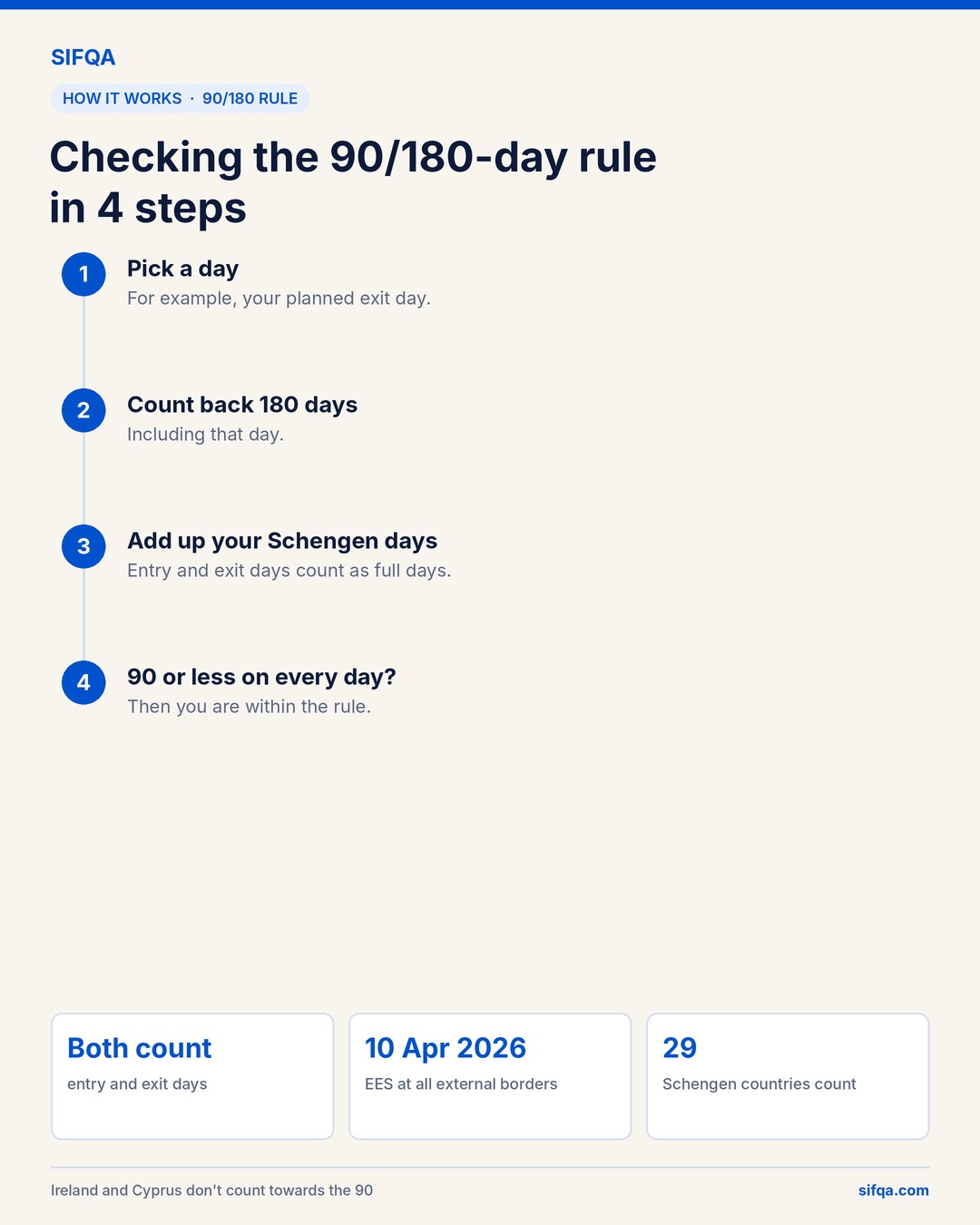
- Pick a day you will be in Schengen, for example your planned exit day.
- Count back 180 days, including that day.
- Add up every day you were in Schengen in that window. Entry and exit days count as full days.
- If the total is 90 or less on every day of your trip, you are within the rule.
Three worked examples
| Example | Earlier days in Schengen | New trip | Latest exit date |
|---|---|---|---|
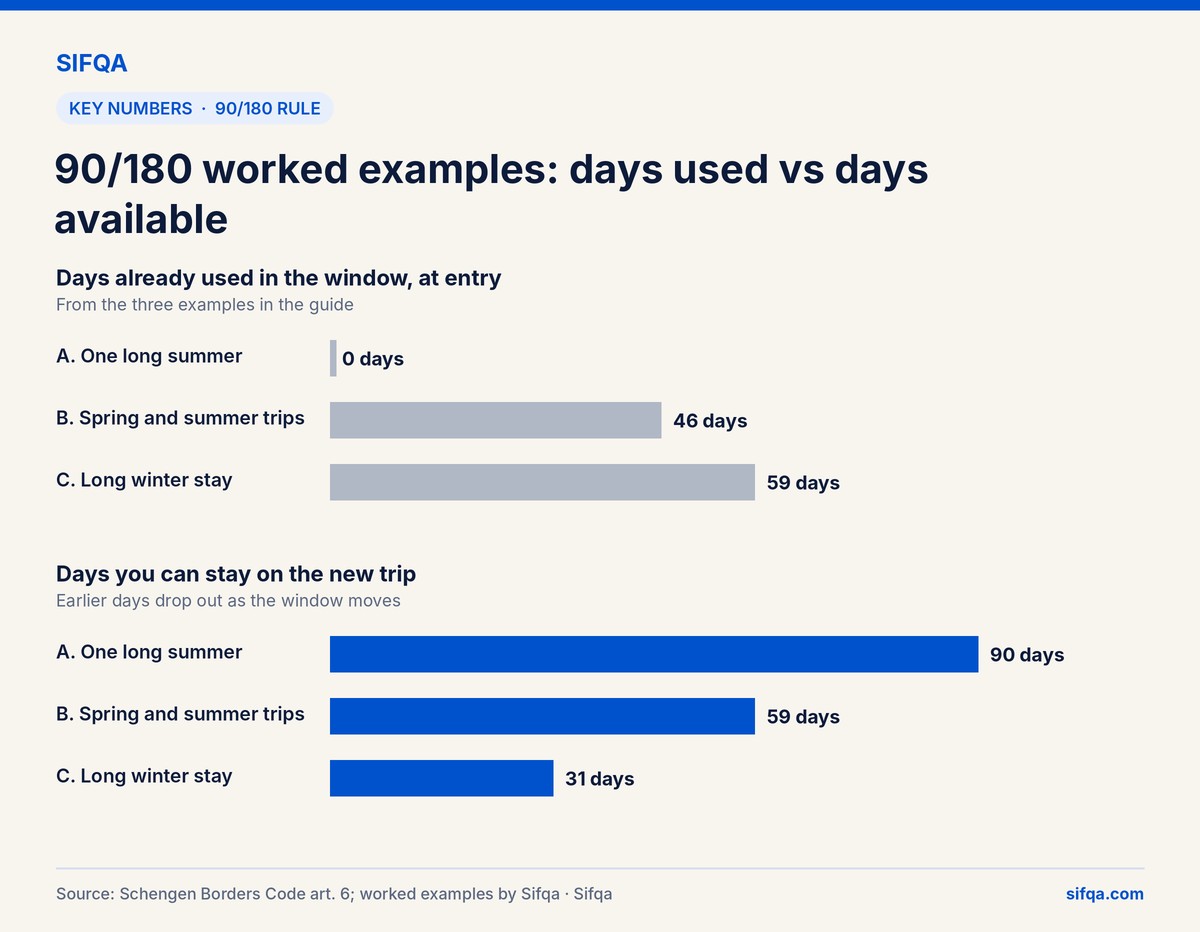
| A. One long summer | None in the last 180 days | Enter 1 June 2027 | 29 August 2027 (90 days including entry and exit) |
| B. Spring and summer trips | 10–24 April 2027 (15 days) and 1–31 July 2027 (31 days) | Enter 1 September 2027 | 29 October 2027. The April days drop out of the window during the trip. |
| C. Long winter stay | 5 January–4 March 2027 (59 days) | Enter 15 April 2027 | 15 May 2027. Only 31 days remain, because all the winter days are still inside the window. |
Example B shows why simple subtraction misleads. On 1 September you have used 46 days, but as the window moves forward the April days fall out, so you can stay 59 days, not just 44.
Which countries count?
| Counts towards your 90 days | Does not count |
|---|---|
| All 29 Schengen countries, including Bulgaria and Romania (full members since 1 January 2025), Switzerland, Norway, Iceland and Liechtenstein | Ireland, Cyprus, the UK, and non-EU Balkan countries such as Serbia, Albania and Montenegro, each with its own rules |
Days spent in a Schengen country on that country’s long-stay visa or residence permit generally don’t count towards the 90 days in that country. Check the rules for travel to other Schengen states.
How EES tracks your days
- What it records: your name, passport, fingerprints and face, plus the date and place of each entry and exit. It applies to non-EU short-stay travellers, with or without a visa.
- Since 10 April 2026 it has run at all external Schengen borders, after a gradual start on 12 October 2025.
- The effect: border guards see your exact days used, and overstays are flagged automatically.
- ETIAS is separate. It is a future travel authorisation for visa-free travellers and had no start date as of October 2026.
What happens if you overstay?
- Penalties vary by country. They can include fines, removal and an entry ban recorded in the Schengen Information System.
- Future applications suffer. A visa that was not “lawfully used” can block the longer multiple-entry visas granted under the cascade rules.
- Missed flights or illness: if you can’t leave in time, contact the local immigration authority before your days run out, with evidence.
Questions people ask
Do the entry and exit days count in the 90/180 rule?
Yes. Both count as full days, even if you arrive late at night or leave early in the morning.
Does a 5-year Schengen visa let me stay longer than 90 days?
No. A multiple-entry visa lets you enter many times over its validity, but each stay still follows the 90 days in any 180 rule.
Does time in Ireland or Cyprus count?
No. Ireland and Cyprus are in the EU but not in the Schengen area, so days there don’t count towards the 90.
Do Emiratis follow the 90/180 rule?
Yes. Emirati citizens are visa-free for short stays but are limited to 90 days in any 180-day period, like everyone else.
How do I check how many days I have left?
Enter your past trips into a 90/180 calculator, such as Sifqa’s calculator or the European Commission’s short-stay calculator.
Related guides
- Schengen 90/180-day calculator
- Multiple-entry Schengen visas from the UAE: the cascade rules
- The Balkans with a Schengen visa
Sources
- French Ministry for Europe and Foreign Affairs: EES in full operation from 10 April 2026
- European Commission: Schengen visa policy
- SchengenVisaInfo: ETIAS has no launch date (19 October 2026)
Written by Asad Waleed M, Dubai. Asad has lived in the UAE for nine years and researches visa rules from government sources. He is not an immigration lawyer or consultant, and Sifqa does not process applications or sell visa services. Read the editorial policy.
Last checked 5 November 2026. Found an error? Email ionicwaleed@gmail.com and it will be fixed and logged.